
Locked vs. Cryptographically Sealed: The BFU/AFU Timeline Deciding Your Yavapai County Case
This article discusses publicly documented forensic standards and vendor security architecture. It does not claim that any particular method was used in any specific case.
A deputy in Chino Valley seizes a phone. It has to get to Prescott. Or further. Booked, logged, driven, shelved in a property room, and eventually handed to whoever actually images it.
Every one of those steps takes hours. Sometimes days. And the entire time, a clock nobody in that chain is watching keeps running inside the phone itself.
If you’re facing charges anywhere in Yavapai County, Prescott, Prescott Valley, Chino Valley, Camp Verde, Cottonwood, that clock might already be the most important fact in your case file, and it will not show up in any report unless someone asks for it by name.
The Silent Property Room Countdown: iOS 18 and GrapheneOS Timer Mechanics
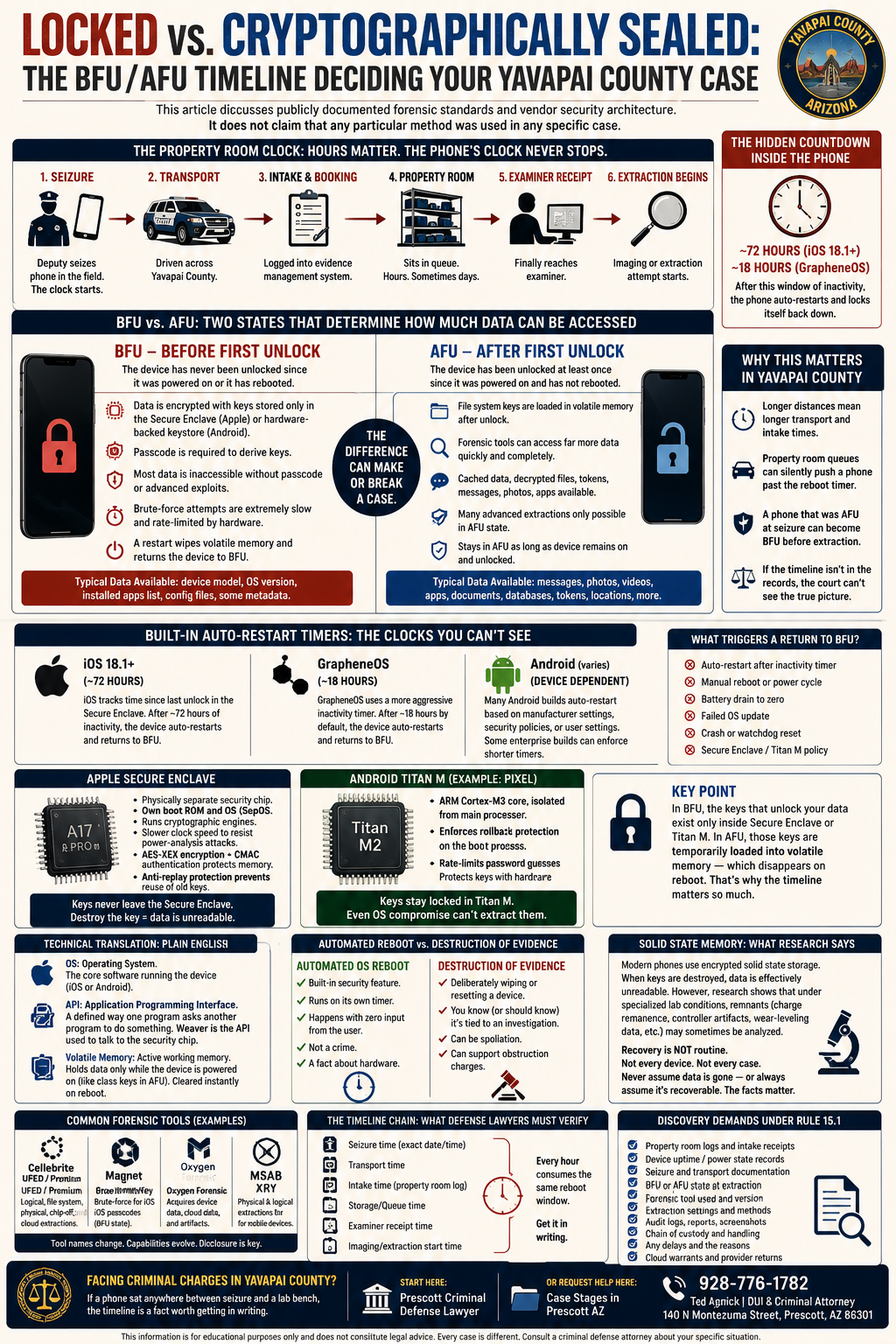
Since iOS 18.1, an iPhone locks itself back down after roughly 72 hours of sitting untouched, no matter what anyone wants.
Apple never announced this. A security researcher named Jiska Classen found it by tearing apart the actual iOS system files and confirmed the phone’s Secure Enclave, its dedicated security chip, tracks the exact time since the last unlock and forces a reboot once that window closes. GrapheneOS, the hardened Android build, runs the same kind of clock at an even tighter 18 hours by default.
Here’s why that number matters more here than almost anywhere else in the state. Yavapai County is not a compact urban grid. A device seized in Chino Valley or Cottonwood or Camp Verde has to travel, get logged into an evidence system, sit in a property room queue, and wait its turn before an examiner ever touches it. Every hour in that chain eats into the same 72-hour window.
This means a phone that was unlocked and accessible at the moment of seizure, sitting in the far more useful AFU state, can silently reboot itself back into the cryptographically sealed BFU state before it ever reaches a lab bench, purely because of transport and intake delay, not because of anything the examiner did wrong.
This is not a hypothetical inefficiency. It is a specific, dated, checkable fact for any given case: how long between seizure and the moment someone actually powered the device or began the extraction. If that gap crossed the threshold, the report needs to say so.
Rule 15.1 Discovery Audits: Forcing the State to Prove Forensic Plausibility
Arizona Rule of Criminal Procedure 15.1 requires the state to disclose existing law enforcement reports connected to the charge, forensic reports included, no later than the preliminary hearing or the arraignment, with anything left over due within 30 days of a superior court arraignment. That deadline is where these questions get answered, or where the gap in the state’s file becomes visible.
Seizure and Transit Logistics
- Exact date and time of seizure at the originating agency, whether that’s Prescott PD, Prescott Valley PD, Chino Valley PD, or the Sheriff’s Office.
- Exact date and time the device was logged into the property room or evidence vault.
- Exact date and time the device actually reached the examiner and imaging began.
Preservation Integrity Verification
- Was the phone kept powered throughout transport and intake, or did it sit dead in a bag on a shelf?
- Was any signal-isolation enclosure used, and was it tested?
- Is there an intake receipt showing the device’s power and lock state at the moment it entered the property room?
Extraction Scope and Baseline State
- Does the forensic report explicitly state whether the device was in BFU or AFU state at the moment of extraction?
- Does the claimed scope of recovered data actually match what’s possible given that documented state?
None of this is buried in a technical appendix somewhere. It’s a plain, direct records request: property room logs, intake receipts, and device uptime records, demanded inside the Rule 15.1 window, not after.
Under the Hood: Secure Enclave and Titan M Hardware Key Wrapping
Every modern iPhone runs a physically separate security chip called the Secure Enclave, soldered onto the same package as the main processor but walled off from it completely. It runs its own boot ROM, its own encryption engine, and its own stripped-down operating system, built on an Apple-customized microkernel deliberately clocked slower than the main processor specifically to resist power-analysis attacks, the kind where an attacker studies a chip’s electricity draw to guess at the secrets inside it.
The Secure Enclave protects its own working memory using AES encryption running in XEX mode, paired with a CMAC authentication tag on every block, which means any tampering with that memory gets caught instantly. On newer chips, Apple backs this further with anti-replay protection, a cryptographic integrity tree rooted in dedicated hardware that makes it mathematically impossible to reuse an old, valid copy of a deleted key, even if someone physically extracts it from the flash chip. That’s the real mechanism behind a factory reset actually working: not deletion, destruction of the one key that made the data readable at all.
Android’s answer to the same problem, on devices like Google’s Pixel line, is a chip called Titan M, built on an ARM Cortex-M3 core and isolated from the main processor for the identical reason Apple isolates its own chip: so a compromised operating system can never reach in and grab the keys directly. Titan M enforces rollback protection on the boot process and rate-limits password guesses through something called the Weaver API. Both chips exist to keep the actual secrets, the raw keys, out of the general-purpose memory that a compromised operating system or a forensic tool could otherwise just read straight out of.
Technical Translation: Cutting Through Forensic Lab Jargon
A few terms worth nailing down before they trip anyone up:
- OS: operating system. The core software running the whole device, iOS or Android, the layer everything else sits on top of.
- API: a defined way for one piece of software to ask another piece of software to do something, without needing to know how it works underneath. Weaver is an API. It’s just the specific channel apps use to ask the security chip to check a password.
- Volatile memory: the phone’s active working memory, the stuff that holds data only while the device is powered on and unlocked, and empties out the instant it reboots. This is where class keys live during AFU. It’s also exactly why a reboot ends AFU access. There’s nothing left to read once the power cuts and the memory clears.
Automated OS Reboots vs. the Legal Realities of Evidence Destruction
These are not the same thing, and mixing them up matters. A phone rebooting itself on its own 72-hour or 18-hour clock is a built-in manufacturer security feature. It happens with zero input from the phone’s owner. Nobody is doing anything wrong when that timer runs out during a transport delay. That is a fact about hardware, not a fact about conduct.
Wiping a phone under investigation is illegal. Resetting or deleting data from a device you know, or reasonably should know, is connected to a pending investigation is spoliation, and it can support a separate obstruction charge entirely apart from whatever the underlying case is about. Courts do not treat that lightly. The distinction is simple: a chip enforcing its own security timer is not a person destroying evidence. A person deliberately triggering a reset after learning about a case is exactly that.
Frequently Asked Questions
How does the property room delay affect a Yavapai County case?
Every hour between seizure and imaging eats into the same 72-hour iOS reboot window. Transport from smaller agencies to a central evidence facility can push a phone from accessible AFU state back into sealed BFU state before an examiner ever sees it.
What should defense counsel demand under Rule 15.1?
Property room logs, intake receipts, and a documented device uptime record showing exactly when the phone was seized, logged, and imaged, disclosed no later than the preliminary hearing or arraignment.
Is a phone rebooting itself the same as someone destroying evidence?
No. An automatic security reboot is a built-in manufacturer feature that runs regardless of anyone’s actions. Deliberately wiping a phone connected to a known investigation is a separate, illegal act.
What is the Secure Enclave?
A physically separate security chip inside modern iPhones that holds encryption keys and never exposes them to the main operating system, even if that operating system is compromised.
Facing Criminal Charges in Yavapai County?
If a phone sat anywhere between seizure and a lab bench, the timeline is a fact worth getting in writing.
Start here: Prescott Criminal Defense Lawyer
or request help here: Case Stages in Prescott AZ
Call 928-776-1782
Ted Agnick | DUI & Criminal Attorney, 140 N Montezuma Street, Prescott, AZ 86301