
Can Police Identify Your Car Without Reading Your License Plate? The Rise of Electronic Fingerprints and SignalTrace
This article discusses publicly documented surveillance technologies, vendor materials, patents, traffic-sensor systems, court records, and investigative reporting. It does not claim that any particular technology was used in any specific case. Every investigation is different.
If you are facing criminal charges in Prescott or anywhere in Yavapai County, one of the most important questions is: “How did law enforcement really identify the vehicle?”
Most people assume police find a car by reading a license plate.
That assumption is no longer complete.
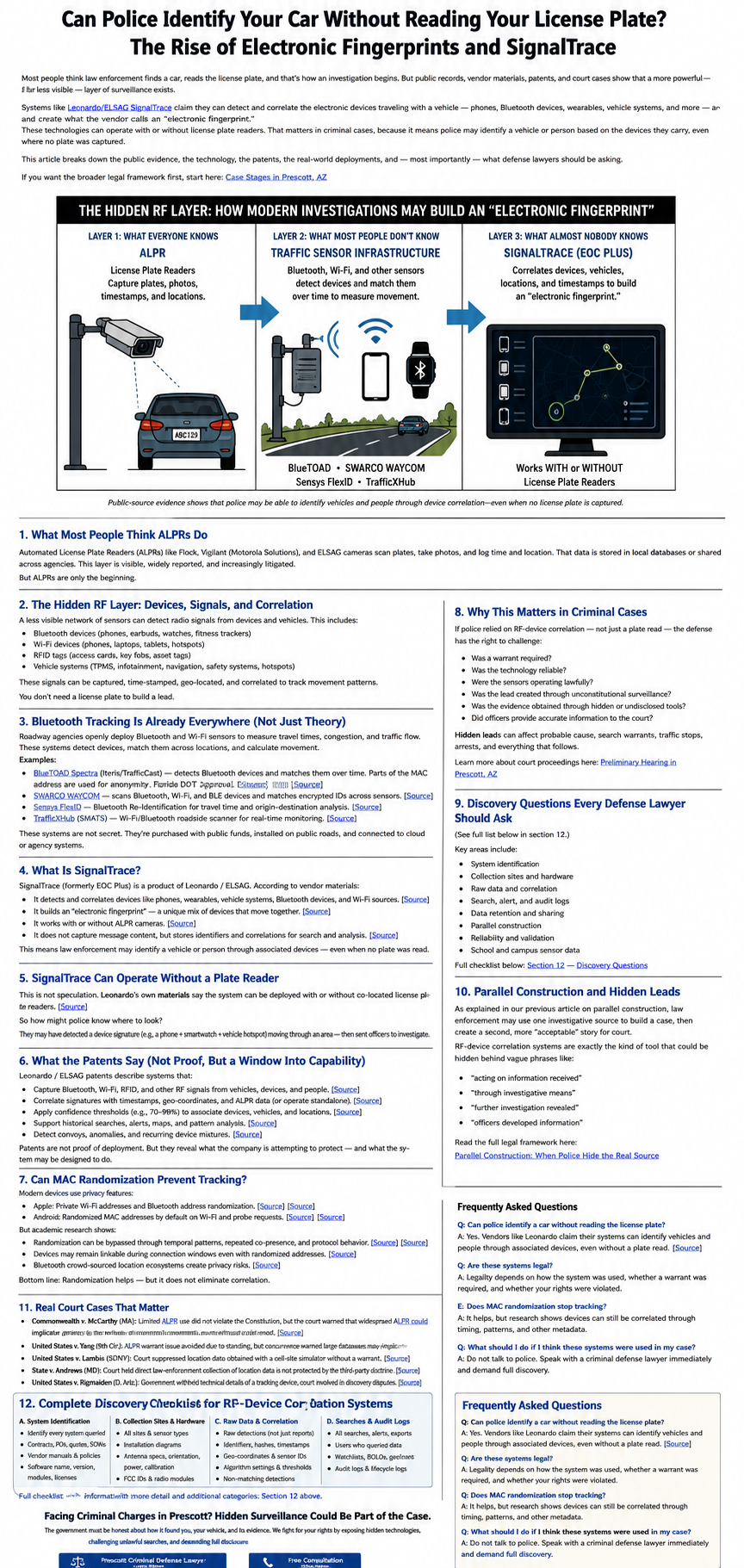
Public vendor materials, patent filings, traffic-sensor documentation, and court cases show that modern vehicle surveillance can involve more than plate reads. Some systems are designed to detect signals from phones, Bluetooth devices, Wi-Fi sources, RFID tags, vehicle components, wearables, and other electronics that travel with or near a vehicle.
One example is SignalTrace, a technology marketed by Leonardo/ELSAG. Leonardo describes SignalTrace as an integrated signal intelligence system that can correlate electronic devices with people, vehicles, locations, timestamps, and license plate reader data when present. ELSAG SignalTrace – Leonardo DRS
The company calls the result an “electronic fingerprint.”
That phrase matters.
Because if investigators can identify a vehicle by the devices traveling with it, the case may not begin with a plate read at all.
It may begin with the hidden RF layer.
If you want the broader legal framework first, start here:
What Is Parallel Construction? When Police Hide the Real Source of an Investigation
First Things First: What Is the Hidden RF Layer?
The hidden RF layer is the invisible cloud of radio-frequency signals surrounding modern life.
Your phone may emit wireless signals.
Your smartwatch may communicate with your phone.
Your earbuds may broadcast identifiers.
Your vehicle may contain Bluetooth, Wi-Fi, tire-pressure sensors, infotainment systems, navigation equipment, hotspots, key fobs, RFID tags, or other connected components.
To most people, these signals are background noise.
To a sensor system, they can become data.
To an investigator, repeated data can become a pattern.
And once a pattern is tied to a vehicle, location, or person, it may become an investigative lead.
Most People Think License Plate Readers Only Read Plates
Automatic license plate readers, often called ALPRs or LPRs, are already powerful tools.
A traditional ALPR system may capture:
- the license plate number,
- a photo of the vehicle,
- the time and date of the scan,
- the camera location,
- and sometimes vehicle descriptors.
That data can answer one obvious question:
“Where was this vehicle seen?”
But SignalTrace-style systems raise a different question:
“What electronic devices were traveling with this vehicle?”
That is a different kind of surveillance.
It moves from vehicle identification into relationship mapping.
What Is SignalTrace?
SignalTrace is a law-enforcement signal intelligence system marketed by Leonardo/ELSAG.
Leonardo says SignalTrace is designed to identify people of interest by the signals emitted from electronic devices they travel with, including fitness trackers, smartwatches, RFID tags, and local signals from mobile phones.
Leonardo – SignalTrace Product Page
The vendor also describes the system as collecting electronic communication patterns and identities from consumer electronics such as vehicle components, Bluetooth, RFID tags, and Wi-Fi sources.
According to Leonardo, SignalTrace can:
- identify movements of electronic devices, individuals, and vehicles,
- store data for later query and analysis,
- recognize a specific vehicle included in an electronic signature even without the license plate number,
- reveal signatures frequently traveling together with an individual or vehicle,
- help identify convoys and movement patterns,
- and perform with or without license plate readers at every collection site.
That last point is important.
The system is marketed as working even when a plate reader is not present at every site.
What Is an Electronic Fingerprint?
Leonardo describes an electronic fingerprint as a specific mix of devices predictably moving together, linked by common timestamps and locations.
The company gives an example involving a license plate, phone, vehicle radio, headphones, sports watch, and key finder forming a recognizable electronic signature.
Leonardo – SignalTrace “How It Works”
In plain English, imagine a vehicle appears in several different places over time.
At each place, the same cluster of signals appears nearby:
- a mobile phone signal,
- a smartwatch,
- wireless headphones,
- a vehicle infotainment system,
- a key finder,
- and a vehicle-related wireless component.
One signal may not prove much.
But the same cluster, appearing together again and again, can become meaningful to an algorithm.
The system may begin treating the vehicle and those devices as a package.
Not because anyone saw the driver.
Not because anyone read the plate.
Because the pattern repeated.
SignalTrace Can Operate With or Without License Plate Readers
This is the part most people miss.
Leonardo states that SignalTrace can perform with or without license plate readers at every collection site.
Leonardo – SignalTrace Product Features
That means the system is not framed only as an add-on to a camera.
It can be part of a broader sensor network.
From a criminal defense perspective, this matters because a police report may say nothing about a plate read.
The lead could still have come from device correlation, signal detection, or a database query.
That does not prove misconduct.
But it absolutely changes the discovery questions.
Bluetooth Tracking Is Already Common in Traffic Systems
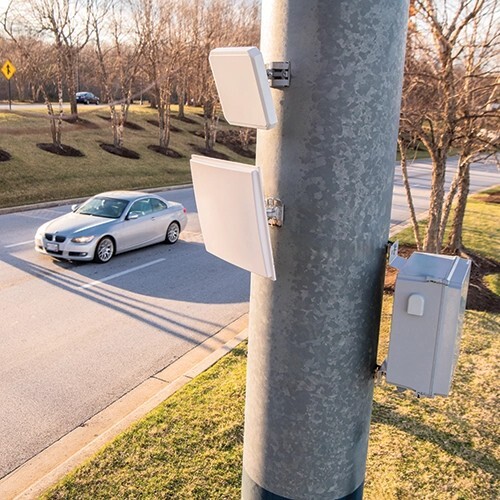
The idea of matching Bluetooth or Wi-Fi detections across locations is not imaginary.
Transportation agencies and traffic vendors have used roadside Bluetooth and Wi-Fi systems to measure travel times, congestion, and origin-destination patterns.
For example, Iteris describes BlueTOAD as a travel-time measurement system that detects and matches Bluetooth devices to calculate speed and travel time.
Iteris – BlueTOAD Travel Time Measurement
SWARCO describes WAYCOM as using Bluetooth, Wi-Fi, and BLE identifiers from vehicles, hands-free kits, and mobile devices to support traffic analysis. Its materials say device identifiers are encrypted and matched between scanners.
SWARCO – WAYCOM 3.1
The point is not that every traffic sensor is a police surveillance system.
The point is narrower and more important:
Roadside device detection and matching is a documented capability.
If that kind of data enters a criminal investigation, defense lawyers need to know what was collected, what was retained, who queried it, and whether it was used to identify a suspect, vehicle, route, or timeline.
What the Patents Say
Patents are not proof that every feature exists in every deployed product.
But patents can reveal what a company is attempting to protect and what a system may be designed to support.
Leonardo/ELSAG patent materials for “Systems and methods for electronic signature tracking” describe collecting and correlating electronic signatures, including Bluetooth, Wi-Fi, RFID, and other RF signals, with visual identifiers such as vehicle information.
Google Patents – US12469097B2
The patent materials describe concepts such as:
- roadside or mobile collection systems,
- Bluetooth, Wi-Fi, RFID, and other RF signal capture,
- timestamps and geographic coordinates,
- correlation with vehicle or visual identifiers,
- searchable databases,
- alerts,
- maps,
- probability or likelihood thresholds,
- and tracking recurring electronic signatures over time.
Again, a patent is not a deployment record.
But if a criminal case appears to involve a device-correlation lead, patent materials can help frame the right technical questions:
- What raw identifiers were collected?
- Were identifiers hashed, encrypted, truncated, or stored in full?
- What time window was used?
- What distance window was used?
- What confidence threshold was applied?
- Was a license plate reader present?
- Were non-matching detections retained?
- Was any exculpatory data omitted from the report?
Can MAC Randomization Prevent This?
A tech-savvy reader may ask:
“Don’t phones randomize their MAC addresses now?”
Yes. Modern devices include privacy protections.
Apple explains that Private Wi-Fi Address allows Apple devices to use a different Wi-Fi address on each network, and newer versions may rotate that address in certain situations.
Apple Support – Use Private Wi-Fi Addresses
Android also documents MAC randomization behavior for Wi-Fi connections.
Android Open Source Project – MAC Randomization Behavior
But privacy protections are not magic cloaks.
Academic research has documented ways device tracking can still occur through timing, repeated co-presence, protocol behavior, persistent randomized addresses during connection windows, and other metadata.
Temporal Pattern Analysis of Wi-Fi Probe Requests
That does not mean every device is always trackable.
It means the defense should not assume MAC randomization ends the inquiry.
The better question is:
What exactly did the system collect, store, correlate, and query?
Why This Matters in Criminal Cases
In a criminal case, the technology matters because the first lead matters.
If police say they stopped a vehicle because of a traffic violation, but the vehicle was already flagged through an RF-device correlation system, that may be significant.
If officers say they “located” a suspect vehicle, the defense may need to ask:
Located how?
If a database associated a device cluster with a car, the defense may need to know:
- Was the association reliable?
- Was the data stale?
- Was there a warrant?
- Was a warrant required?
- Were other similar devices nearby?
- Did the system produce false positives?
- Were confidence scores or probability thresholds used?
- Were audit logs preserved?
- Was the tool disclosed to the defense?
These questions can matter during preliminary hearings, suppression motions, plea negotiations, and trial.
How Courts Have Looked at ALPR and Location Technology
Courts are still working through how older Fourth Amendment rules apply to modern location databases.
In Commonwealth v. McCarthy, the Massachusetts Supreme Judicial Court held that limited ALPR use on two bridges did not trigger constitutional protection in that case. But the court also warned that widespread ALPR use could raise privacy concerns involving the whole of a person’s public movements.
Commonwealth v. McCarthy
In United States v. Yang, the Ninth Circuit did not decide the broader ALPR warrant issue because of standing, but the case shows how courts may ask whether a database reveals isolated sightings or a larger picture of movement over time.
United States v. Yang
Cell-site simulator cases also matter by analogy. In United States v. Lambis, a federal court suppressed evidence after law enforcement used a cell-site simulator to locate a device inside an apartment without a warrant supported by probable cause for that use.
United States v. Lambis
In State v. Andrews, Maryland’s high court addressed Stingray/Hailstorm technology and explained why direct government collection of phone-location information raised serious Fourth Amendment concerns.
State v. Andrews
These cases do not answer every SignalTrace question.
But they show why courts care about scale, scope, disclosure, direct collection, hidden technology, and the ability to reconstruct a person’s movements.
How This Connects to Parallel Construction
The biggest danger is not simply that a tool exists.
The bigger danger is that the tool creates the lead, but the official story begins later.
A report may say:
- “officers located the vehicle,”
- “acting on information received,”
- “through investigative means,”
- “a routine traffic stop was conducted,”
- or “the suspect vehicle was observed in the area.”
Those phrases may be accurate.
But they may also be incomplete.
If an RF sensor, ALPR system, SignalTrace-style correlation, traffic sensor, fusion center, or task-force database generated the first lead, the defense may need to know that.
That is exactly why we wrote:
What Is Parallel Construction? When Police Hide the Real Source of an Investigation
Discovery Questions Every Defense Lawyer Should Ask
If a criminal case may involve ALPR, RF-device correlation, Bluetooth/Wi-Fi detection, or hidden sensor data, the defense should ask targeted questions.
System Identification
- Was any ALPR, SignalTrace, EOC Plus, ELSAG EOC, Leonardo, Selex ES, Bluetooth, Wi-Fi, RFID, traffic-sensor, fusion-center, or task-force system queried?
- What software name, version, module, license package, and enabled features were active at the time?
- Were any vendors, analysts, federal agencies, or neighboring agencies involved?
Collection Sites and Hardware
- What collection sites contributed to the lead?
- Was each site fixed, mobile, trailer-mounted, temporary, covert, cellular-connected, or cloud-connected?
- Were installation diagrams, site photos, antenna details, calibration records, and maintenance logs preserved?
Raw Data and Correlation
- Were raw detections preserved?
- Were identifiers stored, hashed, truncated, encrypted, or transformed?
- What timestamps, geolocation data, sensor IDs, plate reads, images, confidence scores, and non-matching detections exist?
- How did the system define “electronic fingerprint,” “device signature,” “correlated device,” or “traveling together”?
Search, Alert, and Audit Logs
- Who searched the system?
- What was searched?
- Were alerts, watchlists, exports, downloads, or screenshots created?
- Were audit logs preserved?
Data Retention and Sharing
- How long were raw detections, ALPR images, correlated signatures, and query logs retained?
- Was data shared with another agency, vendor, task force, school, transportation agency, or fusion center?
- Were any deletion logs or retention schedules produced?
Parallel Construction
- What was the first investigative lead in chronological order?
- Did any report, affidavit, or testimony omit a sensor-derived lead?
- Were there any nondisclosure agreements, vendor limits, or agency policies restricting disclosure?
These questions are not theatrics.
They are how you find out whether the report tells the whole story.
For the broader process, see:
What Police Reports May Leave Out
Police reports often focus on what the officer personally saw or did.
That does not always reveal how the target was selected.
A report may describe:
- a traffic stop,
- a vehicle search,
- a warrant service,
- an arrest,
- or a “known vehicle” being located.
But behind that report may be:
- an ALPR hit,
- a SignalTrace query,
- a Bluetooth/Wi-Fi detection,
- a traffic-sensor record,
- a task-force communication,
- a fusion-center alert,
- or a database association.
That missing first step can matter.
If you or a loved one was recently arrested, this guide may also help:
What to Do If You Are Arrested in Prescott, AZ
Frequently Asked Questions About SignalTrace and Electronic Fingerprints
What is SignalTrace?
SignalTrace is a law-enforcement signal intelligence system marketed by Leonardo/ELSAG. According to the vendor, it is designed to detect and correlate electronic device signals with people, vehicles, locations, timestamps, and license plate reader data when present.
What is an electronic fingerprint?
An electronic fingerprint is a recurring mix of devices, signals, timestamps, and locations that may be associated with a vehicle, person, route, or group over time.
Can police identify a car without reading the license plate?
Some vendor materials claim that SignalTrace can recognize a vehicle included in an electronic signature even without a license plate number. Whether that happened in a specific case depends on the facts, records, and discovery.
Does SignalTrace read text messages or phone content?
Leonardo says SignalTrace does not decrypt or read the contents of devices or communications. The issue is not message content; the issue is device-signal detection, storage, querying, and correlation.
Are Bluetooth and Wi-Fi traffic sensors real?
Yes. Traffic vendors and transportation agencies have used Bluetooth and Wi-Fi detection systems to measure travel times, congestion, and movement patterns. Criminal defense questions arise if that data is accessed or used as part of a criminal investigation.
Does MAC randomization stop all device tracking?
No. MAC randomization can reduce some tracking, but research and device documentation show that timing, repeated co-presence, protocol behavior, and other metadata may still support correlation in some circumstances.
Would a police report always say if SignalTrace or RF sensors were used?
Not necessarily. A report may use vague language like “information received,” “investigative lead,” or “located the vehicle.” Targeted discovery may be needed to determine whether a hidden sensor-derived lead was involved.
Can this kind of evidence be challenged in court?
Potentially. A defense lawyer may challenge whether the technology was lawfully used, whether records were disclosed, whether the tool was reliable, and whether the results were used to create probable cause or identify a suspect.
What should I do if I think hidden surveillance technology was used in my case?
Do not try to explain the case to police. It is usually best to remain silent and speak with a criminal defense lawyer who can request discovery and examine how the investigation really began.
Facing Criminal Charges in Prescott? Ask How the Investigation Really Started
Modern investigations may begin long before the traffic stop, warrant, search, or arrest.
They may begin with a plate read.
Or a Bluetooth detection.
Or a Wi-Fi signal.
Or an electronic fingerprint.
Or a database query no one mentions in the first police report.
If you are facing charges in Prescott, Prescott Valley, or anywhere in Yavapai County, the source of the evidence matters. A criminal defense lawyer can examine whether hidden technology, incomplete reports, or undisclosed investigative tools played a role in your case.
Start here:
Prescott Criminal Defense Lawyer
or request help here: