
The “Digital Plant” Defense: When Data Ends Up on Your Phone Without Your Knowledge
This article analyzes publicly documented forensic science standards, federal and Arizona evidentiary rules, operating system architectures, database journaling mechanics, and sworn allegations in international cyber incidents. It explores the technical and legal reality that modern mobile devices are multi-writer environments. Nothing in this article creates an attorney-client relationship; it is a forensic guide to digital evidence litigation in Yavapai County and across Arizona.
You wake up in a booking cell at the Yavapai County Detention Center in Camp Verde.
A detective sits across from you in an interview room, drops a three-inch thick spiral-bound report on the table, and points to an extracted text message, a contact card, a cryptocurrency wallet address, or a deleted document.
Then comes the hammer:
“It’s on your phone. That means it’s yours.”
In criminal law, that assumption is treated like gospel. Prosecutors call it constructive possession. They rely on a simple syllogism: you own the phone, the phone holds the file, therefore you knowingly put it there.
It’s clean. It’s neat. It convinces grand juries. And technologically, it is fundamentally flawed.
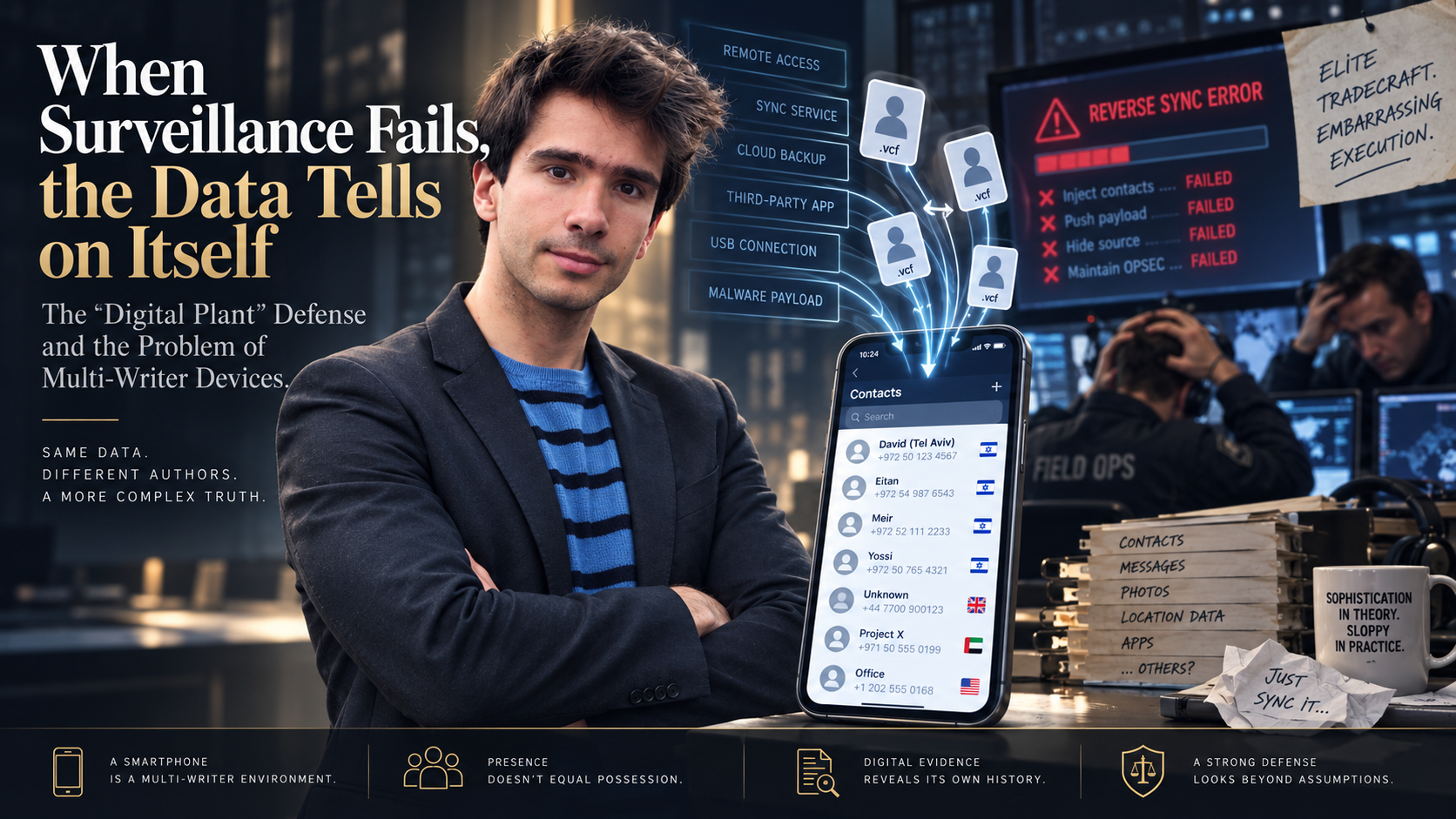
In August 2026, an international incident exposed what elite security researchers have known for years. Juan Branco, a prominent international defense lawyer representing victims before the International Criminal Court (ICC), reported an anomaly on his hardened GrapheneOS smartphone. During an alleged state-level surveillance intrusion, a command-and-control (C2) payload misfired. Instead of silently exfiltrating his data, the external server glitched and reverse-injected thousands of foreign contacts including personal numbers for Silicon Valley executives and foreign officials straight into his local database.
While the press treated this as an international espionage mystery, criminal defense lawyers saw something much bigger: an undeniable technical blueprint for the “Dig
ital Plant” defense.
If an external server, a background cloud sync, a malicious application, or even a police extraction tool can push, write, or stage data onto a smartphone without the owner ever touching the screen, the prosecution’s entire assumption of possession shatters.
1. The Legal Illusion: Presence Does Not Equal Authorship
In any criminal trial—whether it’s a drug conspiracy charge alleging coded text messages, a white-collar fraud indictment involving hidden financial files, or allegations of digital contraband the State must prove two independent elements under Arizona law (A.R.S. § 13-105) and federal law:
- Physical or Constructive Control: That you had dominion over the item.
- Mens Rea (Knowledge): That you knowingly obtained, possessed, or controlled it.
The United States Supreme Court held in Henderson v. United States (575 U.S. 622) that constructive possession requires both the power and the intention to exercise direction or control over an item.
Simply proving that a piece of solid-state flash memory holds a series of 1s and 0s does not prove you put it there, wanted it there, or even knew it existed.
In United States v. Flyer (633 F.3d 911), the Ninth Circuit drew a strict line between files sitting in unallocated storage space and files subject to knowing possession. Machine storage location alone cannot substitute for evidence that the human being actually knew about the data.
Similarly, in the landmark digital authentication case United States v. Vayner (767 F.3d 114), the Second Circuit ruled that the government cannot satisfy Federal Rule of Evidence 901 simply by showing that a digital file contains a defendant’s name
or sits on a device. The government must prove authorship and provenance.
THE EVIDENTIARY GAP
File Found on Flash Chip≠User Downloaded File
Contact Saved in Database≠User Knew the Contact
Cryptographic Hash of Extraction Image≠Integrity of Pre-Seizure Device
2. The Multi-Writer Reality: How Data Infiltrates Modern Devices
Most defense lawyers treat a smartphone like a locked diary. We treat it for what it actually is: a networked Linux or Darwin computer executing hundreds of concurrent background processes across an array of read/write databases.
Android, for example, does not use a single flat file for contacts, messages, or media. Its entire ContactsProvider architecture is intentionally engineered around a multi-source model. It aggregates records from Google accounts, Nextcloud, Microsoft Exchange, SIM cards, messaging apps (Signal, WhatsApp, Telegram), and system daemons into a centralized relational SQLite database: contacts2.db.
Data can be written to that database through multiple pathways that never involve human fingers:
- Background Sync Adapters: Cloud accounts automatically push updates, shared contacts, and sync tokens to the device during silent background cycles.
- Third-Party Application Daemons: Applications with write permissions can silently populate database tables through provider APIs.
- Paired Host Workstations: If a phone was ever tethered to a desktop or laptop via USB with Android Debug Bridge (ADB) or media sync enabled, a compromised host computer can execute silent write transactions.
- Command-and-Control (C2) Payload Glitches: As illustrated in the Juan Branco incident, when surveillance software, remote management tools, or zero-day payloads fail during memory-injection routines, automated rollback protocols can reverse direction writing external staging data into local tables instead of reading it.
3. The Forensic Dirty Secret: Police Extraction Tools Write to Your Phone
When the police crime lab analyst takes the witness stand in a Prescott courtroom, they will testify with rehearsed confidence:
“We used industry-standard Cellebrite UFED and GrayKey devices. Our process is strictly read-only and forensically sound.”
This is demonstrably inaccurate.
While forensic software does not alter the *resulting image file* once created, the physical act of extracting data from a modern, locked, encrypted smartphone often requires modifying the target device itself.
Public patent filings strip away the vendor marketing:
- Magnet Forensics Patent (US 12,613,987 B2, Issued April 28, 2026): Titled “Digital forensics access and extraction,” this patent explicitly discloses an extraction device that installs an access agent directly onto the target smartphone. That agent gathers target data, creates target-side data structures, transforms into an extraction agent, and is later deleted from the phone.
- Cellebrite Patent (US 12,069,151 B2): Documents methods where an external computer pushes an Android-specific collection agent into the connected phone via ADB or MTP interfaces to parse private app storage.
- Oxygen Forensics Android Agent: Publicly details the routine deployment of an executable application pushed onto target storage to extract artifacts that the OS otherwise locks.
Think about what that means in a criminal courtroom:
The government takes a phone into evidence. They hook it up to an extraction rig. That rig pushes an executable program *into* the phone’s volatile memory or flash storage. It creates temporary files, stages data, runs scripts, and deletes its own footprint.
Then the government hands your defense lawyer a SHA-256 hash verifying that the image file hasn’t changed since the cop saved it to his hard drive.
A post-extraction hash proves that the police didn’t alter the copy. It proves absolutely nothing about what the forensic tools altered on the physical phone before and during the extraction.
4. Hardware-Level Proof: How We Audit the Low-Level Code
Claiming “maybe it was a glitch” or “maybe someone hacked me” is amateur hour. In a serious criminal case, an unsubstantiated claim of malware or planting will be dismissed by a judge as self-serving speculation.
At our firm, we build the defense on verifiable low-level artifacts:
A. Auditing the SQLite Write-Ahead Log (-wal)
Modern mobile databases don’t write directly to main database files instantly. They write transactions to a temporary journal called a Write-Ahead Log (WAL). If an image is acquired properly, the .db-wal and .db-shm files contain the exact commit sequence. We look for:
- Transaction Timestamps: Did the incriminating contact or file commit at 3:14 AM while you were asleep, without any corresponding screen-on or unlock events?
- User ID (UID) Verification: Android sandboxes every app under its own Linux UID. Did the disputed row originate from the user-facing interface, or did a background system daemon or unmapped package write it?
- Batch Commit Anomalies: Were hundreds of rows injected in a single millisecond block (the hallmark of an automated API or sync script) rather than human keystrokes?
B. Hardware Memory Tagging Extension (ARM MTE) Logs
On modern hardware platforms like the Google Pixel 8, 9, and 10 running hardened operating systems like GrapheneOS, the processor hardware enforces ARM MTE. MTE prevents memory corruption by assigning 4-bit tags to pointers and memory blocks.
If commercial spyware attempts a classic Use-After-Free exploit to quietly take over the phone, the processor detects the tag mismatch and halts execution. We examine kernel panic logs and crash dumps to determine if a memory fault occurred immediately prior to an unexplained database change.
5. What Real Technical Competence Looks Like in Criminal Defense
Most criminal defense lawyers are liberal arts majors who break into a cold sweat when confronted with a hex editor. They see a 200-page Cellebrite PDF full of text messages and immediately start negotiating a plea deal.
Under ABA Model Rule 1.1, Comment 8, an attorney has an ethical duty to keep abreast of the benefits and risks associated with relevant technology. In modern criminal litigation, that duty is not optional.
When you retain our firm for a complex digital evidence case in Yavapai County or federal court, we do not accept the government’s PDF report. Here is our procedural protocol:
Step 1: Demand the Native Bit-Stream Image Under Rule 15
Under Arizona Rule of Criminal Procedure 15.1 and Federal Rule of Criminal Procedure 16(a)(1)(E), we demand the raw, unparsed physical or advanced logical forensic image (E01, RAW, or DD format), along with all accompanying -wal and -shm database journals. A PDF printout is hearsay; the raw byte stream is evidence.
Step 2: Subpoena the Tool Configuration and Agent Logs
We demand the exact software build, firmware version, and extraction methodology used by the state lab. If the tool deployed a target-side agent (under the Magnet or Cellebrite patents), we demand the audit logs showing every file written, executed, and deleted from your device by the police during the process.
Step 3: File Targeted Motions to Suppress & In Limine
If the prosecution cannot establish who authored the data, we file targeted motions under Rule 901 (Lack of Authentication) and Rule 702 (Daubert/Kumho Tire Challenge). If the government’s extraction tool modified the device without preserving pre-acquisition logs, we raise spoliation and due-process challenges under Arizona v. Youngblood and California v. Trombetta.
6. The Master Cross-Examination: Confronting the State’s Tech Expert
When a police investigator or forensic technician takes the stand, we do not ask open-ended questions. We box them into the technical reality of their own tools:
- “Officer, you did not personally observe my client type this message or save this file, correct?”
- “Your entire conclusion rests on the fact that the record was extracted from the phone’s storage?”
- “The Android operating system routinely allows cloud sync adapters, apps, and daemons to write records without user interaction, doesn’t it?”
- “When you connected the phone to your extraction workstation, did your software install an executable agent onto the phone?”
- “Did you calculate a cryptographic hash of the phone’s physical flash storage *before* that agent was executed?”
- “Did you preserve and audit the SQLite Write-Ahead Log to see which specific application process committed the write?”
- “Your tool cannot distinguish between a database row typed by a human finger and one injected by an automated background script, can it?”
7. Frequently Asked Questions: Smartphone Forensics & Digital Defense
Can files really end up on my phone without me downloading them?
Yes. Automatic cloud syncing, shared media streams, malicious application background tasks, mobile malware, and tethered PC sync utilities can all commit files and database entries to storage without active user interaction or alerts.
If the police have a Cellebrite report with my name on it, is that an open-and-shut case?
No. A Cellebrite report is simply an automated parser’s interpretation of raw data. It shows that the data was present at the time of extraction. It does not prove who put it there, when it was placed there, whether it was placed there by an external program, or if you ever knew it existed.
What is the difference between a hash of an image and device integrity?
A cryptographic hash (like SHA-256) taken after extraction only proves that the police haven’t altered their copy of the data. It does not prove that the phone wasn’t modified prior to or during the extraction process by malware, sync errors, or forensic agents deployed by the extraction hardware itself.
How does GrapheneOS or a hardened phone affect a criminal case?
Devices running hardened operating systems like GrapheneOS enforce strict sandboxing, USB port kill switches, and hardware Memory Tagging (ARM MTE). These features make zero-day attacks harder and create distinct crash and memory logs that can provide critical evidence of an attempted external intrusion or failed data injection.
Facing Serious Charges in Prescott or Yavapai County? Audit the Technology.
When your freedom is on the line, you cannot afford a defense attorney who treats digital forensics like a black box.
Whether your case involves drug trafficking allegations, white-collar financial crimes, computer offenses, or complex felony charges in Prescott, Prescott Valley, Chino Valley, Cottonwood, or Camp Verde, you have the constitutional right to challenge the government’s machine evidence.
We understand the code. We understand the databases. We understand how to force the State to prove its case beyond a reasonable doubt.
Start your defense strategy here:
Prescott Criminal Defense Lawyer – Ted Agnick
Review the procedural timeline of your case:
Criminal Case Stages in Prescott, AZ
Call 928-776-1782
Ted Agnick | DUI & Criminal Attorney
140 N Montezuma Street
Prescott, AZ 86301