
How Police Secretly Score You: Predictive Policing, Red Flag Watch Lists, and Hidden Threat Scores
This article discusses publicly documented predictive policing systems, government reports, court cases, investigative reporting, and privacy guidance. It does not claim that any particular system was used in any specific Prescott or Yavapai County case. Every investigation is different.
Imagine this.
You call 911 in an emergency.
The dispatcher pulls up your address.
Your name appears.
And somewhere on the screen, there is a warning, risk flag, prior-contact note, watch-list marker, or threat score you have never seen.
You have never been convicted.
Maybe you have never even been charged.
But some system decided you were worth extra attention.
That is the world of predictive policing, risk scoring, and data-driven watch lists.
If you are facing criminal charges in Prescott or anywhere in Yavapai County, the question is not only what police did after they
contacted you.
The deeper question is:
“Why were police looking at you in the first place?”
That question matters because hidden scores, watch lists, prior-contact databases, and algorithmic alerts can influence how police treat a person long before a traffic stop, search, arrest, or police report.
If you want the broader legal framework first, start here:
What Is Parallel Construction? When Police Hide the Real Source of an Investigation
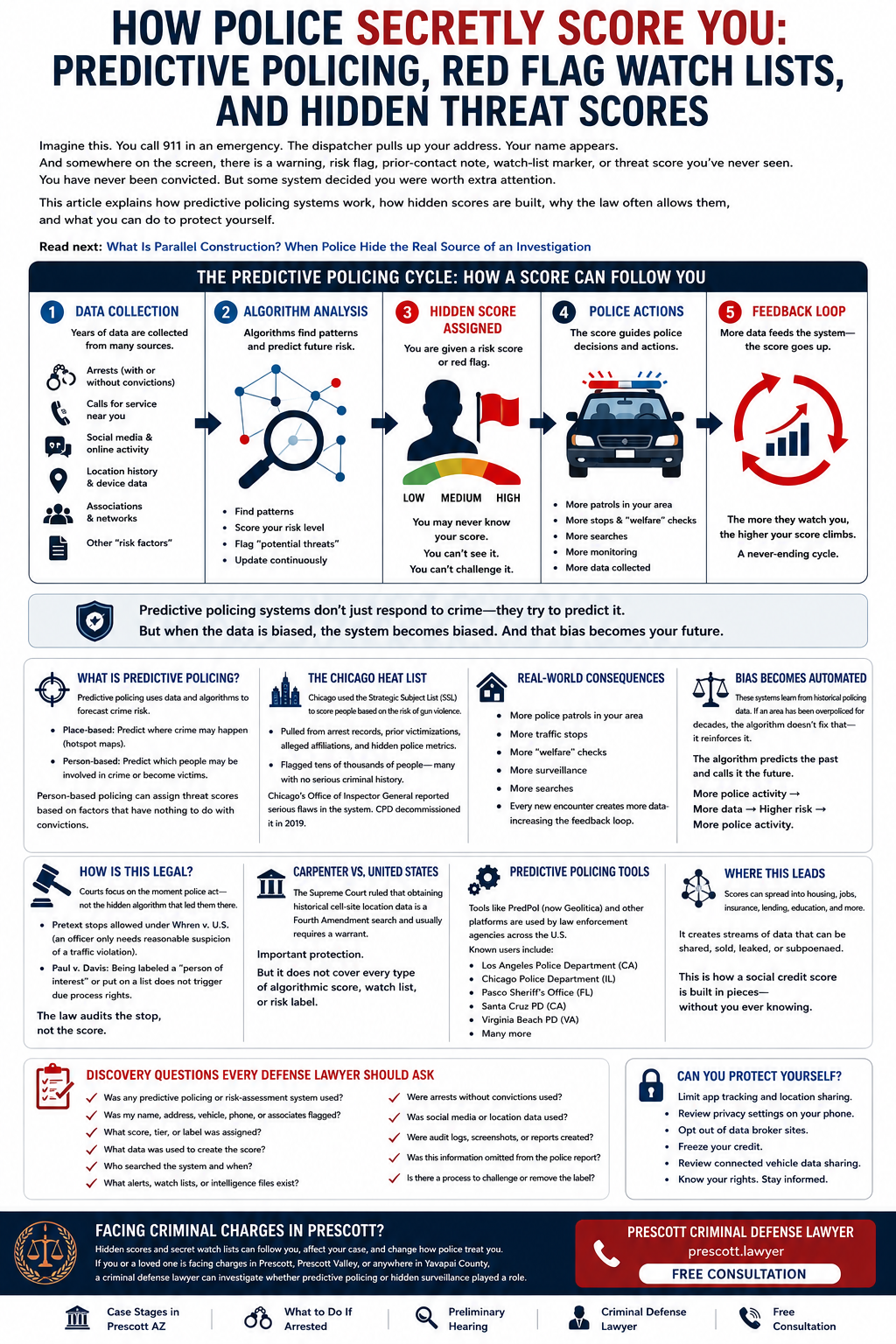
This infographic explains how predictive policing systems may collect data, assign hidden risk scores, and create feedback loops that increase police attention.
First Things First: What Is Predictive Policing?
Predictive policing uses data, software, statistics, or machine-learning models to forecast crime risk.
There are two major types:
- Place-based predictive policing: systems that predict where crime may happen, often through hotspot maps.
- Person-based predictive policing: systems that rate, rank, flag, or prioritize people based on predicted risk.
Place-based tools may tell officers to patrol a certain area.
Person-based tools are more personal.
They may identify specific people as likely to be involved in crime, likely to be victimized, likely to reoffend, or likely to be connected to violence.
That second category is where things get dangerous.
Because a person-based score can be built from data that has nothing to do with a conviction.
What Data Can Create a Police “Red Flag”?
A hidden police risk score may be influenced by data such as:
- prior arrests, even without convictions,
- past police contacts,
- calls for service near your address,
- proximity to prior incidents,
- alleged gang or group associations,
- social network analysis,
- location history,
- license plate reader hits,
- social media activity,
- school or juvenile records in some systems,
- and patterns the algorithm treats as risky.
The problem is obvious.
A person can be flagged because of where they live, who they know, who called police near them, or what a database thinks their pattern resembles.
Not because a judge found them guilty.
Not because a jury convicted them.
Because the system predicted risk.
The Chicago Heat List: A Real-World Warning
One of the best-known person-based predictive policing systems was Chicago’s Strategic Subject List, often called the “Heat List.”
The Chicago Office of Inspector General reported that the Chicago Police Department used predictive risk models known as the Strategic Subject List and Crime and Victimization Risk Model. These models were designed to predict whether someone would become a “party to violence,” either as a victim or offender in a shooting.
Chicago OIG – Advisory Concerning CPD Predictive Risk Models
The OIG reported that the system produced risk scores or risk tiers and that CPD ultimately decommissioned the program in 2019.
RAND also described Chicago’s Strategic Subject List as an effort to identify people most at risk of gun violence and refer them for intervention.
RAND – CPD’s Heat List and the Dilemma of Predictive Policing
That sounds clean on paper.
But in practice, a risk score can become a police attention magnet.
Once a person is placed on a list, police contact may increase.
More contact creates more records.
More records can reinforce the score.
That is the feedback loop.
The Feedback Loop: How the Score Feeds Itself
Predictive policing systems often learn from historical police data.
That includes arrests, stops, reports, field interviews, calls for service, and prior police activity.
But historical police data is not neutral.
If one neighborhood has been heavily policed for years, the data will show more police activity there.
The algorithm may then treat that area as higher risk.
More officers get sent there.
More stops happen.
More reports get written.
The system then sees more data and concludes:
“This place is risky.”
That is how the past gets repackaged as prediction.
The algorithm does not have to be malicious.
It only has to learn from a data trail that already reflects unequal enforcement.
Pasco County: When Predictive Policing Became Home Visits
Another major warning sign came from Pasco County, Florida.
The Tampa Bay Times reported on the Pasco Sheriff’s Office program that tried to predict people who might commit future crimes. Reporting described repeated home visits and intense attention toward people and families identified by the system.
Tampa Bay Times – Pasco Sheriff’s Predictive Policing Investigation
Public reporting later described a settlement involving Pasco’s controversial data-driven policing program, with the sheriff’s office agreeing to pay plaintiffs and being barred from implementing a similar program in the future.
Creative Loafing Tampa Bay – Pasco Predictive Policing Settlement
The lesson is simple:
A score is not just a number.
A score can become a knock on the door.
A welfare check.
A traffic stop.
A field interview.
A search.
A new report.
And then the loop starts again.
How This Can Affect a Criminal Case
In a criminal case, hidden scoring matters because it may explain why police focused on a person before the official report begins.
A police report may say:
- “officers were in the area,”
- “officers recognized the subject,”
- “officers conducted extra patrol,”
- “acting on information received,”
- “the subject was known to law enforcement,”
- or “the vehicle was associated with prior incidents.”
Those phrases may be true.
But they may also hide the first step.
Was there a score?
Was there a watch list?
Was there an alert?
Was there a database flag?
Was there a “known offender,” “chronic offender,” “prolific offender,” “gang associate,” “party to violence,” or “high-risk” label?
Those labels can influence police behavior even if they never appear clearly in the police report.
Why Pretext Stops Make This Even More Powerful
Predictive policing becomes especially important when combined with pretext traffic stops.
In Whren v. United States, the U.S. Supreme Court held that an officer’s subjective motive does not invalidate a traffic stop if the stop is objectively supported by a traffic violation.
Whren v. United States
That means the hidden score does not always have to be the official reason for the stop.
It may simply be the reason police focused on the person long enough to find another reason.
For example:
- a database flags a person as high risk,
- officers start watching the person or vehicle,
- officers observe a minor traffic violation,
- the official report cites only the traffic violation,
- and the hidden score disappears from the story.
That is why the beginning of the investigation matters.
The report may explain the stop.
But discovery may be needed to explain the surveillance before the stop.
Why Due Process May Not Protect You From a Hidden Label
People often assume that if the government labels them dangerous, high risk, or suspicious, they must get a hearing to challenge it.
That assumption is not always correct.
In Paul v. Davis, the U.S. Supreme Court held that damage to reputation alone did not create a protected liberty or property interest under the Due Process Clause.
Paul v. Davis
That does not mean police can do anything they want.
But it does help explain why hidden labels are hard to fight.
If a person is quietly treated as “high risk,” “known,” “flagged,” or “watchlisted,” there may be no automatic notice, no automatic appeal, and no obvious way to correct the record.
That is the danger.
The score can affect police behavior before the person ever learns the score exists.
Where Carpenter Fits In
There is one major privacy case that matters in this discussion: Carpenter v. United States.
In Carpenter, the U.S. Supreme Court held that obtaining historical cell-site location information is generally a Fourth Amendment search requiring a warrant supported by probable cause.
Carpenter v. United States
That case matters because the Court recognized that long-term digital location data can reveal deeply private information about a person’s life.
But Carpenter did not solve every predictive policing problem.
It did not specifically decide how courts should handle every algorithmic score, police risk list, watch-list label, data-broker record, ALPR database, social network analysis, or local intelligence file.
That is why hidden scores remain legally slippery.
The law often audits the stop.
It does not always audit the score that made police watch you first.
Predictive Policing Is Not Always Called Predictive Policing
One reason these systems are hard to spot is that agencies may use different names.
A system may be called:
- intelligence-led policing,
- data-driven policing,
- risk terrain modeling,
- focused deterrence,
- chronic offender tracking,
- prolific offender tracking,
- real-time crime center analytics,
- threat assessment,
- high-risk offender monitoring,
- gang intelligence,
- or public safety analytics.
The label is less important than the function.
If the system collects data, assigns risk, prioritizes people, triggers police action, or creates hidden watch lists, it should be examined.
How This Connects to Parallel Construction
Predictive policing fits directly into the same problem we discussed in our parallel construction article.
The hidden system may create the lead.
The official report may begin later.
A person may be flagged by an algorithm, but the final police report may say only that officers saw a traffic violation, received a tip, or located a known vehicle.
That matters because the defense may never learn the real reason police focused on the person.
Read the full companion article here:
What Is Parallel Construction? When Police Hide the Real Source of an Investigation
Discovery Questions Every Defense Lawyer Should Ask
If a criminal case may involve predictive policing, hidden risk scoring, watch lists, intelligence databases, or data-driven policing, the defense should ask targeted questions.
System Identification
- Was any predictive policing, intelligence-led policing, real-time crime center, risk assessment, gang intelligence, chronic offender, prolific offender, or high-risk list queried?
- What software, database, vendor, or internal system was used?
- What names were used for the system at the time of the investigation?
- Was the defendant, address, vehicle, phone number, associate, or family member flagged?
Score and Label Records
- Was any risk score, threat tier, red flag, alert, watch-list label, or officer safety warning assigned?
- Who assigned it?
- When was it assigned?
- What data caused the label?
- Was the label reviewed by a human?
- Was there any process to correct or remove the label?
Data Inputs
- Did the system use arrests that did not lead to convictions?
- Did it use calls for service?
- Did it use social media?
- Did it use school, housing, probation, gang, ALPR, phone, or location data?
- Did it use associations with other people?
- Did it use neighborhood-level police activity?
Audit Logs and Searches
- Who searched the defendant’s name?
- Who searched the address?
- Who searched the vehicle?
- Were alerts generated?
- Were screenshots, exports, bulletins, BOLOs, or officer safety notes created?
- Were audit logs preserved?
Parallel Construction
- What was the first investigative lead in chronological order?
- Did any report omit a score, alert, watch-list hit, intelligence file, or database flag?
- Did officers rely on a hidden score before developing the official reason for contact?
- Were prosecutors told about the score?
- Was the defense told?
These questions are not conspiracy theories.
They are discovery questions.
For the broader court process, see:
Can You Reduce the Data Feeding These Systems?
You should never destroy evidence, violate a court order, interfere with an investigation, or lie to police.
But lawful privacy hygiene is different.
If data systems feed on location history, app tracking, advertising identifiers, data brokers, connected vehicles, and public records, you can take basic steps to reduce unnecessary data exposure.
Phone Privacy Settings
- Review app location permissions.
- Turn precise location off for apps that do not need it.
- Disable unnecessary app tracking permissions.
- Review microphone, camera, and location access logs.
- Limit ad personalization where possible.
Data Broker and Credit Privacy
The Federal Trade Commission explains that credit freezes are free and can help prevent identity thieves from opening new accounts in your name.
FTC – Credit Freezes and Fraud Alerts
The FTC also explains how prescreened credit and insurance offers work and how consumers can opt out.
FTC – Prescreened Offers for Credit and Insurance
Connected Vehicle Data
- Review your vehicle’s connected-services app.
- Look for driving-score, smart-driver, insurance-sharing, or data-sharing settings.
- Turn off optional sharing you do not want.
- Check whether your vehicle shares driving behavior with third parties.
The goal is not to hide crimes.
The goal is to stop feeding unnecessary personal data into systems you cannot see, audit, or correct.
What Police Reports May Leave Out
A police report may be accurate and still incomplete.
Reports often describe the final contact:
- the stop,
- the search,
- the arrest,
- the warrant,
- or the officer’s observations.
But the start of the investigation may involve:
- a predictive policing score,
- a watch-list hit,
- a real-time crime center alert,
- a “known offender” label,
- a social network analysis,
- a license plate reader alert,
- a fusion-center bulletin,
- or a data-driven patrol assignment.
That missing first step can matter.
If you or a loved one was recently arrested, this guide may also help:
What to Do If You Are Arrested in Prescott, AZ
Frequently Asked Questions About Predictive Policing and Hidden Threat Scores
What is predictive policing?
Predictive policing uses data, statistics, software, or algorithms to forecast crime risk. Some systems focus on places, while others focus on people.
Can police put someone on a watch list without a conviction?
In some systems, yes. Watch lists or risk scores may be based on arrests, associations, police contacts, calls for service, location data, or other factors, not just convictions.
Will I know if I am on a police watch list?
Not always. Many police risk labels, officer safety alerts, intelligence files, and internal watch lists are not automatically disclosed to the person being labeled.
Can a hidden score lead to more police attention?
Yes. A risk score or watch-list label may influence patrols, stops, field interviews, welfare checks, surveillance, or how officers interpret future encounters.
Is predictive policing always illegal?
No. Predictive policing is not automatically illegal. But it can raise serious constitutional, discovery, reliability, equal protection, and due process concerns depending on how it is used.
Can a defense lawyer challenge a predictive policing score?
Potentially. A defense lawyer may request discovery, audit logs, policies, score records, data inputs, vendor materials, and communications to determine whether a hidden score affected the investigation.
How does predictive policing connect to pretext stops?
A hidden score may cause police to focus on someone. Officers may later justify the stop with a minor traffic violation. That makes the hidden lead important in discovery.
What should I do if I think I was targeted by a hidden police score?
Do not argue with police or try to explain the case. Remain silent, avoid consenting to searches, and speak with a criminal defense lawyer who can investigate how the contact really began.
Facing Criminal Charges in Prescott? Ask Why Police Focused on You
Modern policing is no longer just patrol cars and reports.
It can involve databases.
Scores.
Watch lists.
Risk tiers.
Algorithms.
Alerts you never see.
If you are facing charges in Prescott, Prescott Valley, or anywhere in Yavapai County, the source of the investigation matters. A criminal defense lawyer can examine whether hidden scoring, predictive policing, incomplete reports, or undisclosed investigative tools played a role in your case.
Start here:
Prescott Criminal Defense Lawyer
or request help here: