Hi, How Can We Help You?

Author Archives: admin

Locked vs. Cryptographically Sealed: The BFU/AFU Timeline Deciding Your Yavapai County Case

This article discusses publicly documented forensic standards and vendor security architecture. It does not claim that any particular method was used in any specific case.

A deputy in Chino Valley seizes a phone. It has to get to Prescott. Or further. Booked, logged, driven, shelved in a property room, and eventually handed to whoever actually images it.

Every one of those steps takes hours. Sometimes days. And the entire time, a clock nobody in that chain is watching keeps running inside the phone itself.

If you’re facing charges anywhere in Yavapai County, Prescott, Prescott Valley, Chino Valley, Camp Verde, Cottonwood, that clock might already be the most important fact in your case file, and it will not show up in any report unless someone asks for it by name.


The Silent Property Room Countdown: iOS 18 and GrapheneOS Timer Mechanics

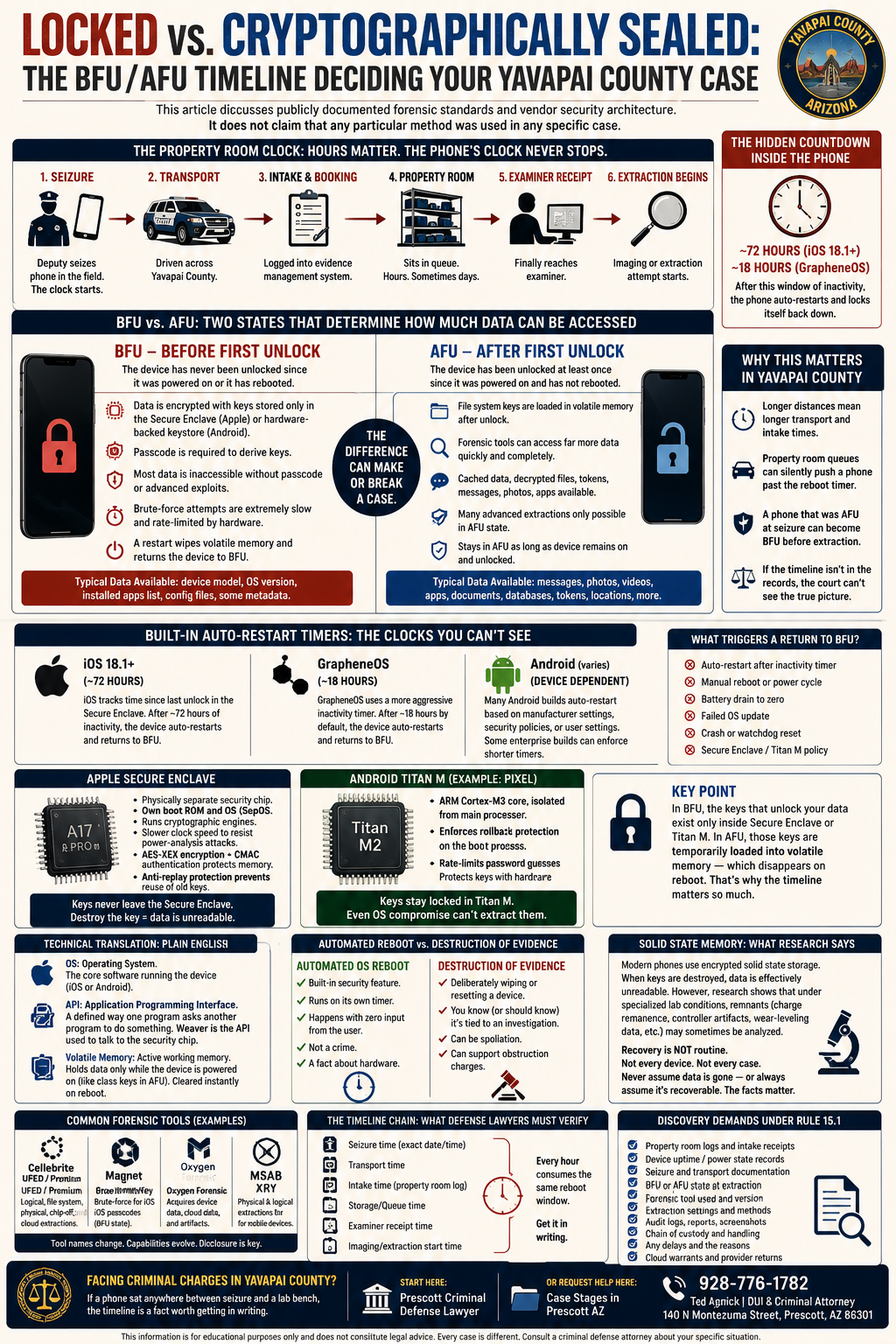
Infographic displaying the difference between Before First Unlock (BFU) and After First Unlock (AFU) cryptographic phone states and the iOS 18 / GrapheneOS auto-reboot countdown timelines for Yavapai County criminal defense.
How a phone’s internal security timers alter what a forensic examiner can extract over time.

Since iOS 18.1, an iPhone locks itself back down after roughly 72 hours of sitting untouched, no matter what anyone wants.

Apple never announced this. A security researcher named Jiska Classen found it by tearing apart the actual iOS system files and confirmed the phone’s Secure Enclave, its dedicated security chip, tracks the exact time since the last unlock and forces a reboot once that window closes. GrapheneOS, the hardened Android build, runs the same kind of clock at an even tighter 18 hours by default.

Here’s why that number matters more here than almost anywhere else in the state. Yavapai County is not a compact urban grid. A device seized in Chino Valley or Cottonwood or Camp Verde has to travel, get logged into an evidence system, sit in a property room queue, and wait its turn before an examiner ever touches it. Every hour in that chain eats into the same 72-hour window.

This means a phone that was unlocked and accessible at the moment of seizure, sitting in the far more useful AFU state, can silently reboot itself back into the cryptographically sealed BFU state before it ever reaches a lab bench, purely because of transport and intake delay, not because of anything the examiner did wrong.

This is not a hypothetical inefficiency. It is a specific, dated, checkable fact for any given case: how long between seizure and the moment someone actually powered the device or began the extraction. If that gap crossed the threshold, the report needs to say so.


Rule 15.1 Discovery Audits: Forcing the State to Prove Forensic Plausibility

Arizona Rule of Criminal Procedure 15.1 requires the state to disclose existing law enforcement reports connected to the charge, forensic reports included, no later than the preliminary hearing or the arraignment, with anything left over due within 30 days of a superior court arraignment. That deadline is where these questions get answered, or where the gap in the state’s file becomes visible.

Seizure and Transit Logistics

  • Exact date and time of seizure at the originating agency, whether that’s Prescott PD, Prescott Valley PD, Chino Valley PD, or the Sheriff’s Office.
  • Exact date and time the device was logged into the property room or evidence vault.
  • Exact date and time the device actually reached the examiner and imaging began.

Preservation Integrity Verification

  • Was the phone kept powered throughout transport and intake, or did it sit dead in a bag on a shelf?
  • Was any signal-isolation enclosure used, and was it tested?
  • Is there an intake receipt showing the device’s power and lock state at the moment it entered the property room?

Extraction Scope and Baseline State

  • Does the forensic report explicitly state whether the device was in BFU or AFU state at the moment of extraction?
  • Does the claimed scope of recovered data actually match what’s possible given that documented state?

None of this is buried in a technical appendix somewhere. It’s a plain, direct records request: property room logs, intake receipts, and device uptime records, demanded inside the Rule 15.1 window, not after.


Under the Hood: Secure Enclave and Titan M Hardware Key Wrapping

Every modern iPhone runs a physically separate security chip called the Secure Enclave, soldered onto the same package as the main processor but walled off from it completely. It runs its own boot ROM, its own encryption engine, and its own stripped-down operating system, built on an Apple-customized microkernel deliberately clocked slower than the main processor specifically to resist power-analysis attacks, the kind where an attacker studies a chip’s electricity draw to guess at the secrets inside it.

The Secure Enclave protects its own working memory using AES encryption running in XEX mode, paired with a CMAC authentication tag on every block, which means any tampering with that memory gets caught instantly. On newer chips, Apple backs this further with anti-replay protection, a cryptographic integrity tree rooted in dedicated hardware that makes it mathematically impossible to reuse an old, valid copy of a deleted key, even if someone physically extracts it from the flash chip. That’s the real mechanism behind a factory reset actually working: not deletion, destruction of the one key that made the data readable at all.

Android’s answer to the same problem, on devices like Google’s Pixel line, is a chip called Titan M, built on an ARM Cortex-M3 core and isolated from the main processor for the identical reason Apple isolates its own chip: so a compromised operating system can never reach in and grab the keys directly. Titan M enforces rollback protection on the boot process and rate-limits password guesses through something called the Weaver API. Both chips exist to keep the actual secrets, the raw keys, out of the general-purpose memory that a compromised operating system or a forensic tool could otherwise just read straight out of.


Technical Translation: Cutting Through Forensic Lab Jargon

A few terms worth nailing down before they trip anyone up:

  • OS: operating system. The core software running the whole device, iOS or Android, the layer everything else sits on top of.
  • API: a defined way for one piece of software to ask another piece of software to do something, without needing to know how it works underneath. Weaver is an API. It’s just the specific channel apps use to ask the security chip to check a password.
  • Volatile memory: the phone’s active working memory, the stuff that holds data only while the device is powered on and unlocked, and empties out the instant it reboots. This is where class keys live during AFU. It’s also exactly why a reboot ends AFU access. There’s nothing left to read once the power cuts and the memory clears.

Automated OS Reboots vs. the Legal Realities of Evidence Destruction

These are not the same thing, and mixing them up matters. A phone rebooting itself on its own 72-hour or 18-hour clock is a built-in manufacturer security feature. It happens with zero input from the phone’s owner. Nobody is doing anything wrong when that timer runs out during a transport delay. That is a fact about hardware, not a fact about conduct.

Wiping a phone under investigation is illegal. Resetting or deleting data from a device you know, or reasonably should know, is connected to a pending investigation is spoliation, and it can support a separate obstruction charge entirely apart from whatever the underlying case is about. Courts do not treat that lightly. The distinction is simple: a chip enforcing its own security timer is not a person destroying evidence. A person deliberately triggering a reset after learning about a case is exactly that.


Frequently Asked Questions

How does the property room delay affect a Yavapai County case?

Every hour between seizure and imaging eats into the same 72-hour iOS reboot window. Transport from smaller agencies to a central evidence facility can push a phone from accessible AFU state back into sealed BFU state before an examiner ever sees it.

What should defense counsel demand under Rule 15.1?

Property room logs, intake receipts, and a documented device uptime record showing exactly when the phone was seized, logged, and imaged, disclosed no later than the preliminary hearing or arraignment.

Is a phone rebooting itself the same as someone destroying evidence?

No. An automatic security reboot is a built-in manufacturer feature that runs regardless of anyone’s actions. Deliberately wiping a phone connected to a known investigation is a separate, illegal act.

What is the Secure Enclave?

A physically separate security chip inside modern iPhones that holds encryption keys and never exposes them to the main operating system, even if that operating system is compromised.


Facing Criminal Charges in Yavapai County?

If a phone sat anywhere between seizure and a lab bench, the timeline is a fact worth getting in writing.

Start here: Prescott Criminal Defense Lawyer

or request help here: Case Stages in Prescott AZ

Call 928-776-1782

Ted Agnick | DUI & Criminal Attorney, 140 N Montezuma Street, Prescott, AZ 86301


How Police Secretly Score You: Predictive Policing, Red Flag Watch Lists, and Hidden Threat Scores

Infographic explaining predictive policing threat scores, red flag watch lists, police risk algorithms, and feedback loops in criminal investigations

This article discusses publicly documented predictive policing systems, government reports, court cases, investigative reporting, and privacy guidance. It does not claim that any particular system was used in any specific Prescott or Yavapai County case. Every investigation is different.

Imagine this.

You call 911 in an emergency.

The dispatcher pulls up your address.

Your name appears.

And somewhere on the screen, there is a warning, risk flag, prior-contact note, watch-list marker, or threat score you have never seen.

You have never been convicted.

Maybe you have never even been charged.

But some system decided you were worth extra attention.

That is the world of predictive policing, risk scoring, and data-driven watch lists.

If you are facing criminal charges in Prescott or anywhere in Yavapai County, the question is not only what police did after they

contacted you.

The deeper question is:

“Why were police looking at you in the first place?”

That question matters because hidden scores, watch lists, prior-contact databases, and algorithmic alerts can influence how police treat a person long before a traffic stop, search, arrest, or police report.

If you want the broader legal framework first, start here:

What Is Parallel Construction? When Police Hide the Real Source of an Investigation

This infographic explains how predictive policing systems may collect data, assign hidden risk scores, and create feedback loops that increase police attention.


First Things First: What Is Predictive Policing?

Predictive policing uses data, software, statistics, or machine-learning models to forecast crime risk.

There are two major types:

  • Place-based predictive policing: systems that predict where crime may happen, often through hotspot maps.
  • Person-based predictive policing: systems that rate, rank, flag, or prioritize people based on predicted risk.

Place-based tools may tell officers to patrol a certain area.

Person-based tools are more personal.

They may identify specific people as likely to be involved in crime, likely to be victimized, likely to reoffend, or likely to be connected to violence.

That second category is where things get dangerous.

Because a person-based score can be built from data that has nothing to do with a conviction.


What Data Can Create a Police “Red Flag”?

A hidden police risk score may be influenced by data such as:

  • prior arrests, even without convictions,
  • past police contacts,
  • calls for service near your address,
  • proximity to prior incidents,
  • alleged gang or group associations,
  • social network analysis,
  • location history,
  • license plate reader hits,
  • social media activity,
  • school or juvenile records in some systems,
  • and patterns the algorithm treats as risky.

The problem is obvious.

A person can be flagged because of where they live, who they know, who called police near them, or what a database thinks their pattern resembles.

Not because a judge found them guilty.

Not because a jury convicted them.

Because the system predicted risk.


The Chicago Heat List: A Real-World Warning

One of the best-known person-based predictive policing systems was Chicago’s Strategic Subject List, often called the “Heat List.”

The Chicago Office of Inspector General reported that the Chicago Police Department used predictive risk models known as the Strategic Subject List and Crime and Victimization Risk Model. These models were designed to predict whether someone would become a “party to violence,” either as a victim or offender in a shooting.
Chicago OIG – Advisory Concerning CPD Predictive Risk Models

The OIG reported that the system produced risk scores or risk tiers and that CPD ultimately decommissioned the program in 2019.

RAND also described Chicago’s Strategic Subject List as an effort to identify people most at risk of gun violence and refer them for intervention.
RAND – CPD’s Heat List and the Dilemma of Predictive Policing

That sounds clean on paper.

But in practice, a risk score can become a police attention magnet.

Once a person is placed on a list, police contact may increase.

More contact creates more records.

More records can reinforce the score.

That is the feedback loop.


The Feedback Loop: How the Score Feeds Itself

Predictive policing systems often learn from historical police data.

That includes arrests, stops, reports, field interviews, calls for service, and prior police activity.

But historical police data is not neutral.

If one neighborhood has been heavily policed for years, the data will show more police activity there.

The algorithm may then treat that area as higher risk.

More officers get sent there.

More stops happen.

More reports get written.

The system then sees more data and concludes:

“This place is risky.”

That is how the past gets repackaged as prediction.

The algorithm does not have to be malicious.

It only has to learn from a data trail that already reflects unequal enforcement.


Pasco County: When Predictive Policing Became Home Visits

Another major warning sign came from Pasco County, Florida.

The Tampa Bay Times reported on the Pasco Sheriff’s Office program that tried to predict people who might commit future crimes. Reporting described repeated home visits and intense attention toward people and families identified by the system.
Tampa Bay Times – Pasco Sheriff’s Predictive Policing Investigation

Public reporting later described a settlement involving Pasco’s controversial data-driven policing program, with the sheriff’s office agreeing to pay plaintiffs and being barred from implementing a similar program in the future.
Creative Loafing Tampa Bay – Pasco Predictive Policing Settlement

The lesson is simple:

A score is not just a number.

A score can become a knock on the door.

A welfare check.

A traffic stop.

A field interview.

A search.

A new report.

And then the loop starts again.


How This Can Affect a Criminal Case

In a criminal case, hidden scoring matters because it may explain why police focused on a person before the official report begins.

A police report may say:

  • “officers were in the area,”
  • “officers recognized the subject,”
  • “officers conducted extra patrol,”
  • “acting on information received,”
  • “the subject was known to law enforcement,”
  • or “the vehicle was associated with prior incidents.”

Those phrases may be true.

But they may also hide the first step.

Was there a score?

Was there a watch list?

Was there an alert?

Was there a database flag?

Was there a “known offender,” “chronic offender,” “prolific offender,” “gang associate,” “party to violence,” or “high-risk” label?

Those labels can influence police behavior even if they never appear clearly in the police report.


Why Pretext Stops Make This Even More Powerful

Predictive policing becomes especially important when combined with pretext traffic stops.

In Whren v. United States, the U.S. Supreme Court held that an officer’s subjective motive does not invalidate a traffic stop if the stop is objectively supported by a traffic violation.
Whren v. United States

That means the hidden score does not always have to be the official reason for the stop.

It may simply be the reason police focused on the person long enough to find another reason.

For example:

  • a database flags a person as high risk,
  • officers start watching the person or vehicle,
  • officers observe a minor traffic violation,
  • the official report cites only the traffic violation,
  • and the hidden score disappears from the story.

That is why the beginning of the investigation matters.

The report may explain the stop.

But discovery may be needed to explain the surveillance before the stop.


Why Due Process May Not Protect You From a Hidden Label

People often assume that if the government labels them dangerous, high risk, or suspicious, they must get a hearing to challenge it.

That assumption is not always correct.

In Paul v. Davis, the U.S. Supreme Court held that damage to reputation alone did not create a protected liberty or property interest under the Due Process Clause.
Paul v. Davis

That does not mean police can do anything they want.

But it does help explain why hidden labels are hard to fight.

If a person is quietly treated as “high risk,” “known,” “flagged,” or “watchlisted,” there may be no automatic notice, no automatic appeal, and no obvious way to correct the record.

That is the danger.

The score can affect police behavior before the person ever learns the score exists.


Where Carpenter Fits In

There is one major privacy case that matters in this discussion: Carpenter v. United States.

In Carpenter, the U.S. Supreme Court held that obtaining historical cell-site location information is generally a Fourth Amendment search requiring a warrant supported by probable cause.
Carpenter v. United States

That case matters because the Court recognized that long-term digital location data can reveal deeply private information about a person’s life.

But Carpenter did not solve every predictive policing problem.

It did not specifically decide how courts should handle every algorithmic score, police risk list, watch-list label, data-broker record, ALPR database, social network analysis, or local intelligence file.

That is why hidden scores remain legally slippery.

The law often audits the stop.

It does not always audit the score that made police watch you first.


Predictive Policing Is Not Always Called Predictive Policing

One reason these systems are hard to spot is that agencies may use different names.

A system may be called:

  • intelligence-led policing,
  • data-driven policing,
  • risk terrain modeling,
  • focused deterrence,
  • chronic offender tracking,
  • prolific offender tracking,
  • real-time crime center analytics,
  • threat assessment,
  • high-risk offender monitoring,
  • gang intelligence,
  • or public safety analytics.

The label is less important than the function.

If the system collects data, assigns risk, prioritizes people, triggers police action, or creates hidden watch lists, it should be examined.


How This Connects to Parallel Construction

Predictive policing fits directly into the same problem we discussed in our parallel construction article.

The hidden system may create the lead.

The official report may begin later.

A person may be flagged by an algorithm, but the final police report may say only that officers saw a traffic violation, received a tip, or located a known vehicle.

That matters because the defense may never learn the real reason police focused on the person.

Read the full companion article here:

What Is Parallel Construction? When Police Hide the Real Source of an Investigation


Discovery Questions Every Defense Lawyer Should Ask

If a criminal case may involve predictive policing, hidden risk scoring, watch lists, intelligence databases, or data-driven policing, the defense should ask targeted questions.

System Identification

  • Was any predictive policing, intelligence-led policing, real-time crime center, risk assessment, gang intelligence, chronic offender, prolific offender, or high-risk list queried?
  • What software, database, vendor, or internal system was used?
  • What names were used for the system at the time of the investigation?
  • Was the defendant, address, vehicle, phone number, associate, or family member flagged?

Score and Label Records

  • Was any risk score, threat tier, red flag, alert, watch-list label, or officer safety warning assigned?
  • Who assigned it?
  • When was it assigned?
  • What data caused the label?
  • Was the label reviewed by a human?
  • Was there any process to correct or remove the label?

Data Inputs

  • Did the system use arrests that did not lead to convictions?
  • Did it use calls for service?
  • Did it use social media?
  • Did it use school, housing, probation, gang, ALPR, phone, or location data?
  • Did it use associations with other people?
  • Did it use neighborhood-level police activity?

Audit Logs and Searches

  • Who searched the defendant’s name?
  • Who searched the address?
  • Who searched the vehicle?
  • Were alerts generated?
  • Were screenshots, exports, bulletins, BOLOs, or officer safety notes created?
  • Were audit logs preserved?

Parallel Construction

  • What was the first investigative lead in chronological order?
  • Did any report omit a score, alert, watch-list hit, intelligence file, or database flag?
  • Did officers rely on a hidden score before developing the official reason for contact?
  • Were prosecutors told about the score?
  • Was the defense told?

These questions are not conspiracy theories.

They are discovery questions.

For the broader court process, see:

Case Stages in Prescott AZ


Can You Reduce the Data Feeding These Systems?

You should never destroy evidence, violate a court order, interfere with an investigation, or lie to police.

But lawful privacy hygiene is different.

If data systems feed on location history, app tracking, advertising identifiers, data brokers, connected vehicles, and public records, you can take basic steps to reduce unnecessary data exposure.

Phone Privacy Settings

  • Review app location permissions.
  • Turn precise location off for apps that do not need it.
  • Disable unnecessary app tracking permissions.
  • Review microphone, camera, and location access logs.
  • Limit ad personalization where possible.

Data Broker and Credit Privacy

The Federal Trade Commission explains that credit freezes are free and can help prevent identity thieves from opening new accounts in your name.
FTC – Credit Freezes and Fraud Alerts

The FTC also explains how prescreened credit and insurance offers work and how consumers can opt out.
FTC – Prescreened Offers for Credit and Insurance

Connected Vehicle Data

  • Review your vehicle’s connected-services app.
  • Look for driving-score, smart-driver, insurance-sharing, or data-sharing settings.
  • Turn off optional sharing you do not want.
  • Check whether your vehicle shares driving behavior with third parties.

The goal is not to hide crimes.

The goal is to stop feeding unnecessary personal data into systems you cannot see, audit, or correct.


What Police Reports May Leave Out

A police report may be accurate and still incomplete.

Reports often describe the final contact:

  • the stop,
  • the search,
  • the arrest,
  • the warrant,
  • or the officer’s observations.

But the start of the investigation may involve:

  • a predictive policing score,
  • a watch-list hit,
  • a real-time crime center alert,
  • a “known offender” label,
  • a social network analysis,
  • a license plate reader alert,
  • a fusion-center bulletin,
  • or a data-driven patrol assignment.

That missing first step can matter.

If you or a loved one was recently arrested, this guide may also help:

What to Do If You Are Arrested in Prescott, AZ


Frequently Asked Questions About Predictive Policing and Hidden Threat Scores

What is predictive policing?

Predictive policing uses data, statistics, software, or algorithms to forecast crime risk. Some systems focus on places, while others focus on people.

Can police put someone on a watch list without a conviction?

In some systems, yes. Watch lists or risk scores may be based on arrests, associations, police contacts, calls for service, location data, or other factors, not just convictions.

Will I know if I am on a police watch list?

Not always. Many police risk labels, officer safety alerts, intelligence files, and internal watch lists are not automatically disclosed to the person being labeled.

Can a hidden score lead to more police attention?

Yes. A risk score or watch-list label may influence patrols, stops, field interviews, welfare checks, surveillance, or how officers interpret future encounters.

Is predictive policing always illegal?

No. Predictive policing is not automatically illegal. But it can raise serious constitutional, discovery, reliability, equal protection, and due process concerns depending on how it is used.

Can a defense lawyer challenge a predictive policing score?

Potentially. A defense lawyer may request discovery, audit logs, policies, score records, data inputs, vendor materials, and communications to determine whether a hidden score affected the investigation.

How does predictive policing connect to pretext stops?

A hidden score may cause police to focus on someone. Officers may later justify the stop with a minor traffic violation. That makes the hidden lead important in discovery.

What should I do if I think I was targeted by a hidden police score?

Do not argue with police or try to explain the case. Remain silent, avoid consenting to searches, and speak with a criminal defense lawyer who can investigate how the contact really began.


Facing Criminal Charges in Prescott? Ask Why Police Focused on You

Modern policing is no longer just patrol cars and reports.

It can involve databases.

Scores.

Watch lists.

Risk tiers.

Algorithms.

Alerts you never see.

If you are facing charges in Prescott, Prescott Valley, or anywhere in Yavapai County, the source of the investigation matters. A criminal defense lawyer can examine whether hidden scoring, predictive policing, incomplete reports, or undisclosed investigative tools played a role in your case.

Start here:

Prescott Criminal Defense Lawyer

or request help here:

Free Consultation


Can Police Identify Your Car Without Reading Your License Plate? The Rise of Electronic Fingerprints and SignalTrace


Infographic explaining how police may use ALPR cameras, Bluetooth and Wi-Fi sensors, and SignalTrace-style device correlation to build electronic fingerprints

This article discusses publicly documented surveillance technologies, vendor materials, patents, traffic-sensor systems, court records, and investigative reporting. It does not claim that any particular technology was used in any specific case. Every investigation is different.


If you are facing criminal charges in Prescott or anywhere in Yavapai County, one of the most important questions is: “How did law enforcement really identify the vehicle?”


Most people assume police find a car by reading a license plate.

That assumption is no longer complete.


Public vendor materials, patent filings, traffic-sensor documentation, and court cases show that modern vehicle surveillance can involve more than plate reads. Some systems are designed to detect signals from phones, Bluetooth devices, Wi-Fi sources, RFID tags, vehicle components, wearables, and other electronics that travel with or near a vehicle.


One example is SignalTrace, a technology marketed by Leonardo/ELSAG. Leonardo describes SignalTrace as an integrated signal intelligence system that can correlate electronic devices with people, vehicles, locations, timestamps, and license plate reader data when present. ELSAG SignalTrace – Leonardo DRS


The company calls the result an “electronic fingerprint.”

That phrase matters.

Because if investigators can identify a vehicle by the devices traveling with it, the case may not begin with a plate read at all.

It may begin with the hidden RF layer.

If you want the broader legal framework first, start here:

What Is Parallel Construction? When Police Hide the Real Source of an Investigation


First Things First: What Is the Hidden RF Layer?

The hidden RF layer is the invisible cloud of radio-frequency signals surrounding modern life.

Your phone may emit wireless signals.

Your smartwatch may communicate with your phone.

Your earbuds may broadcast identifiers.

Your vehicle may contain Bluetooth, Wi-Fi, tire-pressure sensors, infotainment systems, navigation equipment, hotspots, key fobs, RFID tags, or other connected components.

To most people, these signals are background noise.

To a sensor system, they can become data.

To an investigator, repeated data can become a pattern.

And once a pattern is tied to a vehicle, location, or person, it may become an investigative lead.


Most People Think License Plate Readers Only Read Plates

Automatic license plate readers, often called ALPRs or LPRs, are already powerful tools.

A traditional ALPR system may capture:

  • the license plate number,
  • a photo of the vehicle,
  • the time and date of the scan,
  • the camera location,
  • and sometimes vehicle descriptors.

That data can answer one obvious question:

“Where was this vehicle seen?”

But SignalTrace-style systems raise a different question:

“What electronic devices were traveling with this vehicle?”

That is a different kind of surveillance.

It moves from vehicle identification into relationship mapping.


What Is SignalTrace?

SignalTrace is a law-enforcement signal intelligence system marketed by Leonardo/ELSAG.

Leonardo says SignalTrace is designed to identify people of interest by the signals emitted from electronic devices they travel with, including fitness trackers, smartwatches, RFID tags, and local signals from mobile phones.
Leonardo – SignalTrace Product Page

The vendor also describes the system as collecting electronic communication patterns and identities from consumer electronics such as vehicle components, Bluetooth, RFID tags, and Wi-Fi sources.

According to Leonardo, SignalTrace can:

  • identify movements of electronic devices, individuals, and vehicles,
  • store data for later query and analysis,
  • recognize a specific vehicle included in an electronic signature even without the license plate number,
  • reveal signatures frequently traveling together with an individual or vehicle,
  • help identify convoys and movement patterns,
  • and perform with or without license plate readers at every collection site.

That last point is important.

The system is marketed as working even when a plate reader is not present at every site.


What Is an Electronic Fingerprint?

Leonardo describes an electronic fingerprint as a specific mix of devices predictably moving together, linked by common timestamps and locations.

The company gives an example involving a license plate, phone, vehicle radio, headphones, sports watch, and key finder forming a recognizable electronic signature.
Leonardo – SignalTrace “How It Works”

In plain English, imagine a vehicle appears in several different places over time.

At each place, the same cluster of signals appears nearby:

  • a mobile phone signal,
  • a smartwatch,
  • wireless headphones,
  • a vehicle infotainment system,
  • a key finder,
  • and a vehicle-related wireless component.

One signal may not prove much.

But the same cluster, appearing together again and again, can become meaningful to an algorithm.

The system may begin treating the vehicle and those devices as a package.

Not because anyone saw the driver.

Not because anyone read the plate.

Because the pattern repeated.


SignalTrace Can Operate With or Without License Plate Readers

This is the part most people miss.

Leonardo states that SignalTrace can perform with or without license plate readers at every collection site.
Leonardo – SignalTrace Product Features

That means the system is not framed only as an add-on to a camera.

It can be part of a broader sensor network.

From a criminal defense perspective, this matters because a police report may say nothing about a plate read.

The lead could still have come from device correlation, signal detection, or a database query.

That does not prove misconduct.

But it absolutely changes the discovery questions.


Bluetooth Tracking Is Already Common in Traffic Systems

The idea of matching Bluetooth or Wi-Fi detections across locations is not imaginary.

Transportation agencies and traffic vendors have used roadside Bluetooth and Wi-Fi systems to measure travel times, congestion, and origin-destination patterns.

For example, Iteris describes BlueTOAD as a travel-time measurement system that detects and matches Bluetooth devices to calculate speed and travel time.
Iteris – BlueTOAD Travel Time Measurement

SWARCO describes WAYCOM as using Bluetooth, Wi-Fi, and BLE identifiers from vehicles, hands-free kits, and mobile devices to support traffic analysis. Its materials say device identifiers are encrypted and matched between scanners.
SWARCO – WAYCOM 3.1

The point is not that every traffic sensor is a police surveillance system.

The point is narrower and more important:

Roadside device detection and matching is a documented capability.

If that kind of data enters a criminal investigation, defense lawyers need to know what was collected, what was retained, who queried it, and whether it was used to identify a suspect, vehicle, route, or timeline.


What the Patents Say

Patents are not proof that every feature exists in every deployed product.

But patents can reveal what a company is attempting to protect and what a system may be designed to support.

Leonardo/ELSAG patent materials for “Systems and methods for electronic signature tracking” describe collecting and correlating electronic signatures, including Bluetooth, Wi-Fi, RFID, and other RF signals, with visual identifiers such as vehicle information.
Google Patents – US12469097B2

The patent materials describe concepts such as:

  • roadside or mobile collection systems,
  • Bluetooth, Wi-Fi, RFID, and other RF signal capture,
  • timestamps and geographic coordinates,
  • correlation with vehicle or visual identifiers,
  • searchable databases,
  • alerts,
  • maps,
  • probability or likelihood thresholds,
  • and tracking recurring electronic signatures over time.

Again, a patent is not a deployment record.

But if a criminal case appears to involve a device-correlation lead, patent materials can help frame the right technical questions:

  • What raw identifiers were collected?
  • Were identifiers hashed, encrypted, truncated, or stored in full?
  • What time window was used?
  • What distance window was used?
  • What confidence threshold was applied?
  • Was a license plate reader present?
  • Were non-matching detections retained?
  • Was any exculpatory data omitted from the report?

Can MAC Randomization Prevent This?

A tech-savvy reader may ask:

“Don’t phones randomize their MAC addresses now?”

Yes. Modern devices include privacy protections.

Apple explains that Private Wi-Fi Address allows Apple devices to use a different Wi-Fi address on each network, and newer versions may rotate that address in certain situations.

Apple Support – Use Private Wi-Fi Addresses

Android also documents MAC randomization behavior for Wi-Fi connections.
Android Open Source Project – MAC Randomization Behavior

But privacy protections are not magic cloaks.

Academic research has documented ways device tracking can still occur through timing, repeated co-presence, protocol behavior, persistent randomized addresses during connection windows, and other metadata.
Temporal Pattern Analysis of Wi-Fi Probe Requests

That does not mean every device is always trackable.

It means the defense should not assume MAC randomization ends the inquiry.

The better question is:

What exactly did the system collect, store, correlate, and query?


Why This Matters in Criminal Cases

In a criminal case, the technology matters because the first lead matters.

If police say they stopped a vehicle because of a traffic violation, but the vehicle was already flagged through an RF-device correlation system, that may be significant.

If officers say they “located” a suspect vehicle, the defense may need to ask:

Located how?

If a database associated a device cluster with a car, the defense may need to know:

  • Was the association reliable?
  • Was the data stale?
  • Was there a warrant?
  • Was a warrant required?
  • Were other similar devices nearby?
  • Did the system produce false positives?
  • Were confidence scores or probability thresholds used?
  • Were audit logs preserved?
  • Was the tool disclosed to the defense?

These questions can matter during preliminary hearings, suppression motions, plea negotiations, and trial.


How Courts Have Looked at ALPR and Location Technology

Courts are still working through how older Fourth Amendment rules apply to modern location databases.

In Commonwealth v. McCarthy, the Massachusetts Supreme Judicial Court held that limited ALPR use on two bridges did not trigger constitutional protection in that case. But the court also warned that widespread ALPR use could raise privacy concerns involving the whole of a person’s public movements.
Commonwealth v. McCarthy

In United States v. Yang, the Ninth Circuit did not decide the broader ALPR warrant issue because of standing, but the case shows how courts may ask whether a database reveals isolated sightings or a larger picture of movement over time.
United States v. Yang

Cell-site simulator cases also matter by analogy. In United States v. Lambis, a federal court suppressed evidence after law enforcement used a cell-site simulator to locate a device inside an apartment without a warrant supported by probable cause for that use.
United States v. Lambis

In State v. Andrews, Maryland’s high court addressed Stingray/Hailstorm technology and explained why direct government collection of phone-location information raised serious Fourth Amendment concerns.
State v. Andrews

These cases do not answer every SignalTrace question.

But they show why courts care about scale, scope, disclosure, direct collection, hidden technology, and the ability to reconstruct a person’s movements.


How This Connects to Parallel Construction

The biggest danger is not simply that a tool exists.

The bigger danger is that the tool creates the lead, but the official story begins later.

A report may say:

  • “officers located the vehicle,”
  • “acting on information received,”
  • “through investigative means,”
  • “a routine traffic stop was conducted,”
  • or “the suspect vehicle was observed in the area.”

Those phrases may be accurate.

But they may also be incomplete.

If an RF sensor, ALPR system, SignalTrace-style correlation, traffic sensor, fusion center, or task-force database generated the first lead, the defense may need to know that.

That is exactly why we wrote:

What Is Parallel Construction? When Police Hide the Real Source of an Investigation


Discovery Questions Every Defense Lawyer Should Ask

If a criminal case may involve ALPR, RF-device correlation, Bluetooth/Wi-Fi detection, or hidden sensor data, the defense should ask targeted questions.

System Identification

  • Was any ALPR, SignalTrace, EOC Plus, ELSAG EOC, Leonardo, Selex ES, Bluetooth, Wi-Fi, RFID, traffic-sensor, fusion-center, or task-force system queried?
  • What software name, version, module, license package, and enabled features were active at the time?
  • Were any vendors, analysts, federal agencies, or neighboring agencies involved?

Collection Sites and Hardware

  • What collection sites contributed to the lead?
  • Was each site fixed, mobile, trailer-mounted, temporary, covert, cellular-connected, or cloud-connected?
  • Were installation diagrams, site photos, antenna details, calibration records, and maintenance logs preserved?

Raw Data and Correlation

  • Were raw detections preserved?
  • Were identifiers stored, hashed, truncated, encrypted, or transformed?
  • What timestamps, geolocation data, sensor IDs, plate reads, images, confidence scores, and non-matching detections exist?
  • How did the system define “electronic fingerprint,” “device signature,” “correlated device,” or “traveling together”?

Search, Alert, and Audit Logs

  • Who searched the system?
  • What was searched?
  • Were alerts, watchlists, exports, downloads, or screenshots created?
  • Were audit logs preserved?

Data Retention and Sharing

  • How long were raw detections, ALPR images, correlated signatures, and query logs retained?
  • Was data shared with another agency, vendor, task force, school, transportation agency, or fusion center?
  • Were any deletion logs or retention schedules produced?

Parallel Construction

  • What was the first investigative lead in chronological order?
  • Did any report, affidavit, or testimony omit a sensor-derived lead?
  • Were there any nondisclosure agreements, vendor limits, or agency policies restricting disclosure?

These questions are not theatrics.

They are how you find out whether the report tells the whole story.

For the broader process, see:

Case Stages in Prescott AZ


What Police Reports May Leave Out

Police reports often focus on what the officer personally saw or did.

That does not always reveal how the target was selected.

A report may describe:

  • a traffic stop,
  • a vehicle search,
  • a warrant service,
  • an arrest,
  • or a “known vehicle” being located.

But behind that report may be:

  • an ALPR hit,
  • a SignalTrace query,
  • a Bluetooth/Wi-Fi detection,
  • a traffic-sensor record,
  • a task-force communication,
  • a fusion-center alert,
  • or a database association.

That missing first step can matter.

If you or a loved one was recently arrested, this guide may also help:

What to Do If You Are Arrested in Prescott, AZ


Frequently Asked Questions About SignalTrace and Electronic Fingerprints

What is SignalTrace?

SignalTrace is a law-enforcement signal intelligence system marketed by Leonardo/ELSAG. According to the vendor, it is designed to detect and correlate electronic device signals with people, vehicles, locations, timestamps, and license plate reader data when present.

What is an electronic fingerprint?

An electronic fingerprint is a recurring mix of devices, signals, timestamps, and locations that may be associated with a vehicle, person, route, or group over time.

Can police identify a car without reading the license plate?

Some vendor materials claim that SignalTrace can recognize a vehicle included in an electronic signature even without a license plate number. Whether that happened in a specific case depends on the facts, records, and discovery.

Does SignalTrace read text messages or phone content?

Leonardo says SignalTrace does not decrypt or read the contents of devices or communications. The issue is not message content; the issue is device-signal detection, storage, querying, and correlation.

Are Bluetooth and Wi-Fi traffic sensors real?

Yes. Traffic vendors and transportation agencies have used Bluetooth and Wi-Fi detection systems to measure travel times, congestion, and movement patterns. Criminal defense questions arise if that data is accessed or used as part of a criminal investigation.

Does MAC randomization stop all device tracking?

No. MAC randomization can reduce some tracking, but research and device documentation show that timing, repeated co-presence, protocol behavior, and other metadata may still support correlation in some circumstances.

Would a police report always say if SignalTrace or RF sensors were used?

Not necessarily. A report may use vague language like “information received,” “investigative lead,” or “located the vehicle.” Targeted discovery may be needed to determine whether a hidden sensor-derived lead was involved.

Can this kind of evidence be challenged in court?

Potentially. A defense lawyer may challenge whether the technology was lawfully used, whether records were disclosed, whether the tool was reliable, and whether the results were used to create probable cause or identify a suspect.

What should I do if I think hidden surveillance technology was used in my case?

Do not try to explain the case to police. It is usually best to remain silent and speak with a criminal defense lawyer who can request discovery and examine how the investigation really began.


Facing Criminal Charges in Prescott? Ask How the Investigation Really Started

Modern investigations may begin long before the traffic stop, warrant, search, or arrest.

They may begin with a plate read.

Or a Bluetooth detection.

Or a Wi-Fi signal.

Or an electronic fingerprint.

Or a database query no one mentions in the first police report.

If you are facing charges in Prescott, Prescott Valley, or anywhere in Yavapai County, the source of the evidence matters. A criminal defense lawyer can examine whether hidden technology, incomplete reports, or undisclosed investigative tools played a role in your case.

Start here:

Prescott Criminal Defense Lawyer

or request help here:

Free Consultation


What Is Parallel Construction? When Police Hide the Real Source of an Investigation 

If you or a loved one is facing criminal charges in Prescott or anywhere in Yavapai County, one of the most important questions is…

Infographic explaining parallel construction in criminal investigations, where police hide the real source of evidence and create a separate official story


“How did law enforcement really find the evidence?”


Sometimes, the official police report tells a simple story: an officer saw something suspicious, made a traffic stop, searched a vehicle, or followed up on an anonymous tip.


But in some investigations, the real starting point may be hidden. A secret database search, cell phone tracking tool, confidential federal tip, license plate reader hit, data-broker search, or surveillance technology may have pointed police in the right direction first.


When law enforcement creates a second, cleaner-looking explanation for how the case began, that practice is often called parallel construction.


This guide explains what parallel construction is, why it matters, and why defendants in Prescott and Yavapai County criminal cases should care about the true source of the evidence.


If you want the full criminal case roadmap first, start here:

Case Stages in Prescott AZ


First Things First: What Is Parallel Construction?

Parallel construction is when law enforcement uses one investigative source to find a lead, but later builds a separate explanation for how that evidence was discovered.

In plain English, it can look like this:

  • A hidden tool or secret tip points police toward a suspect.
  • Police then create a separate investigative path.
  • The official report focuses on the second path.
  • The defense may never learn how the investigation truly began.

Human Rights Watch described parallel construction as the use of alternative explanations for how evidence was found, warning that it can keep courts from reviewing the legality of questionable investigative methods.
Human Rights Watch – Secret Evidence Erodes Fair Trial Rights

This does not mean every police report is false. It means that in some cases, the written report may not reveal the full investigative path.


Why Parallel Construction Matters in a Criminal Case

The source of evidence matters because criminal defendants have the right to challenge illegal searches, unreliable technology, and improper government conduct.

If the real source of a case is hidden, the defense may lose the chance to ask critical questions:

  • Was a warrant required?
  • Was the warrant valid?
  • Was a surveillance tool used?
  • Was the technology reliable?
  • Was the evidence obtained through an illegal search?
  • Was the defendant misidentified?
  • Did officers leave important facts out of the report?

That matters in Prescott felony and misdemeanor cases because early investigative decisions can affect everything that follows, including complaint, indictment, arrest, arraignment, pretrial motions, plea negotiations, and trial.


The DEA Special Operations Division Example

One of the best-known public examples of parallel construction came from reporting on the Drug Enforcement Administration’s Special Operations Division.

Reuters reported that a secretive DEA unit funneled information from intelligence intercepts, wiretaps, informants, and phone-record databases to law enforcement agencies to help launch criminal investigations. According to that reporting, agents were instructed to recreate the investigative trail so the original source would not appear in court records.
Investigative Reporters & Editors summary of Reuters report

EFF also summarized the issue as “intelligence laundering,” explaining that government tips could be used to start investigations while the original source of the information stayed hidden from defendants and courts.
Electronic Frontier Foundation – DEA and NSA Intelligence Laundering

The key point is simple: if an investigation starts with hidden intelligence, the defense may need to know that in order to test whether the case was built legally.


Cell-Site Simulators: The Stingray Secrecy Problem

Another documented example involves cell-site simulators, often called Stingrays. These devices can mimic cell towers and force nearby phones to connect, allowing law enforcement to locate or identify phones.

The ACLU obtained records showing that the FBI continued to impose nondisclosure agreements on law enforcement agencies seeking to use FBI cell-site simulators. Those records raised concerns that secrecy rules could limit what police disclose to courts, prosecutors, defense attorneys, and the public.
ACLU v. FBI – Cell-Site Simulator NDA Records

This matters because a defendant cannot challenge a surveillance tool if no one admits the tool was used.

Arizona has seen related litigation too. In Hodai v. City of Tucson, the ACLU of Arizona challenged Tucson’s refusal to produce Stingray-related public records. The city relied on a nondisclosure agreement involving Harris Corporation, the company associated with Stingray devices.
ACLU of Arizona – Hodai v. City of Tucson


How Parallel Construction Can Show Up in Ordinary Cases

Parallel construction does not always announce itself. It may appear through vague language in police reports, such as:

  • “acting on information received,”
  • “based on an anonymous tip,”
  • “through investigative means,”
  • “officers developed information,”
  • “a known law enforcement database indicated,”
  • “the suspect was located after further investigation.”

None of those phrases automatically proves misconduct. But they can be warning signs that the defense should ask more questions.

For example, a case that appears to begin with a traffic stop may actually have started with:

  • a license plate reader alert,
  • a cell phone location search,
  • a confidential informant tip,
  • a federal task-force alert,
  • facial recognition software,
  • a social media monitoring tool,
  • a private camera network,
  • or a data-broker search.

That hidden first step can matter if the officer later claims the case began only with a “routine” observation.


Modern Tools That Can Create Hidden Investigative Leads

Parallel construction concerns are growing because modern investigations can involve tools that ordinary people may never see in a police report.

License Plate Reader Hits

Automatic license plate readers can scan plates, record vehicle location data, and generate alerts when a vehicle appears in a certain area. If an officer later stops the car for a traffic reason, the report may focus on the traffic violation instead of the original database alert.

Phone Location Data and Data Brokers

Some law enforcement agencies have used commercially available location data products. Those tools can raise serious discovery questions because the data may come from apps, advertising identifiers, or third-party brokers rather than a traditional warrant.

Cell-Site Simulators

A cell-site simulator may help locate a phone, but the official report may not say that such a tool was used unless the defense specifically asks and the court orders disclosure.

Facial Recognition Leads

Facial recognition can generate a lead, but a later investigation may rely on witness identification, surveillance footage, or officer observation instead. The defense may need to know whether software influenced the investigation.

Confidential Informants and Task-Force Tips

Informants and interagency task forces can produce valuable leads, but vague references to “information received” can leave the defense guessing about reliability, bias, or legality.


Why This Is a Fourth Amendment Issue

The Fourth Amendment protects people from unreasonable searches and seizures. If evidence comes from an unlawful search, the defense may be able to ask the court to suppress it.

But suppression motions depend on knowing what happened.

If the real source of the evidence is hidden, a judge may never get the chance to decide whether police used an unconstitutional method.

The U.S. Supreme Court has also limited when evidence is excluded from court. In Herring v. United States, the Court explained that the exclusionary rule focuses heavily on deterrence and law enforcement culpability, not every police mistake automatically results in suppression.
Herring v. United States, 555 U.S. 135 (2009)

That makes accurate disclosure even more important. If the court does not know the real facts, it cannot properly decide whether evidence should be admitted or excluded.


What Defense Lawyers Look for in Discovery

In a Prescott criminal case, discovery is where the defense starts asking what the State actually has and how the case was built.

Important discovery questions may include:

  • Were any law enforcement databases searched?
  • Was a license plate reader involved?
  • Was a cell-site simulator used?
  • Was location data purchased or accessed from a third-party vendor?
  • Was facial recognition used?
  • Was a federal, state, or local task force involved?
  • Was there an informant or confidential source?
  • Were there reports, logs, alerts, emails, or audit trails not included in the police report?
  • Were any search warrants, subpoenas, court orders, or preservation requests used?

These questions are especially important during the preliminary hearing and pretrial stages, when the defense may challenge probable cause, search legality, or the reliability of the State’s evidence.


Why Police Reports May Not Tell the Whole Story

A police report is important, but it is not always the full investigation.

Reports may leave out:

  • database searches,
  • federal task-force communications,
  • surveillance technology logs,
  • informant communications,
  • private camera or ALPR alerts,
  • vendor tools used before the stop,
  • or internal emails between agencies.

That is why early legal representation matters. A defense lawyer can compare the report against body-camera footage, dispatch logs, warrant materials, jail calls, digital evidence, and discovery disclosures.

If you or a loved one was recently arrested, this guide may also help:

What to Do If You Are Arrested in Prescott, AZ


What Can Happen If Parallel Construction Is Exposed?

If the defense uncovers that law enforcement hid the real source of an investigation, several things may happen depending on the facts:

  • The defense may request additional discovery.
  • The court may order the State to disclose records.
  • The defense may file a motion to suppress evidence.
  • The prosecution may have to explain how the investigation truly began.
  • The judge may hold an evidentiary hearing.
  • In some cases, evidence may be excluded.
  • In serious cases, charges may be reduced or dismissed.

The outcome depends on the facts, the technology involved, the legality of the search, and whether the defense can show that the hidden source affected constitutional rights.


Questions to Ask If You Suspect Hidden Surveillance Was Used

If something about the case feels too neat, too fast, or too vague, it may be worth asking:

  • How did police know where to look?
  • How did they identify the vehicle or phone?
  • Why was that person stopped at that exact time?
  • Was the stop truly random?
  • Was an ALPR alert involved?
  • Was a federal agency involved?
  • Were there sealed records or undisclosed warrants?
  • Was the “tip” really from a person, or from a database?

Those questions do not prove the case is invalid. But they can help reveal whether the official story matches the real investigation.


Frequently Asked Questions About Parallel Construction

What is parallel construction in criminal law?

Parallel construction is when law enforcement creates a separate investigative path to explain evidence while hiding the original source that led police to it.

Is parallel construction illegal?

Not every use of parallel construction is automatically illegal, but it can raise serious constitutional, discovery, and fair-trial concerns if it hides unlawful searches or prevents the defense from challenging the evidence.

Why does the source of evidence matter?

The defense has the right to challenge illegal searches, unreliable technology, and improper investigative methods. If the real source is hidden, those challenges may be blocked.

Can parallel construction happen in local cases?

Yes. Even local cases can involve federal tips, task-force information, license plate readers, phone-location tools, informants, or other outside sources.

How can a defense lawyer find hidden investigative tools?

A defense lawyer can request discovery, review reports and videos, examine warrant materials, subpoena records when appropriate, and ask targeted questions about databases, surveillance tools, informants, and interagency communications.

Can evidence be suppressed if the real source was hidden?

Possibly. If the evidence came from an unlawful search or if the State failed to disclose important information, the defense may be able to file a motion to suppress or request other remedies.

Does a vague police report prove parallel construction?

No. Vague language alone does not prove misconduct. But phrases like “information received” or “investigative means” may justify deeper discovery questions.

Should I talk to police if I think hidden surveillance was used?

No. It is usually best to remain silent and speak with a criminal defense lawyer before discussing the facts of the case.


Facing Criminal Charges in Prescott? The Real Source of the Evidence Matters

The official story is not always the whole story. In modern criminal investigations, evidence may begin with databases, surveillance tools, confidential tips, or interagency information that never appears clearly in the first police report.

If you are facing charges in Prescott, Prescott Valley, or anywhere in Yavapai County, a criminal defense lawyer can examine how the investigation really began and whether your rights were violated.

Start here:

Prescott Criminal Defense Lawyer

or request help here:

Free Consultation


Trial Preparation and the Final Management Conference (FMC)

When plea negotiations end without an agreement, a felony case in Yavapai County enters the Trial Preparation phase. This culminates in a critical hearing known as the Final Management Conference (FMC).

The FMC is not about “if” you are going to trial—it is about “how” the trial will be conducted. It is the last time the judge, the prosecutor, and your defense attorney meet to finalize the rules of the courtroom.


What Happens at the Final Management Conference?

The FMC usually occurs 7 to 14 days before the trial date. During this hearing, the judge will confirm the following:

  • Trial Duration: How many days the trial is expected to last.
  • Witness Lists: Finalizing exactly who will be called to testify.
  • Exhibit Lists: Reviewing the physical evidence (photos, videos, documents) that will be shown to the jury.
  • Jury Instructions: Deciding the specific legal definitions the judge will read to the jury before they deliberate.

The “Final” Plea Offer

In many Yavapai County Superior Court cases, the FMC is the absolute deadline for a plea deal. Some judges follow a “no plea” policy after the FMC, meaning if you don’t take the deal today, your only options are to go to trial or plead “to the sheet” (pleading guilty to all charges without a deal).


Motions in Limine: The Battle for Evidence

Leading up to the FMC, your lawyer will often file Motions in Limine. These are legal requests to “limit” or “exclude” certain evidence. For example, if the police obtained a statement in violation of your rights, your attorney will argue at this stage that the jury should never hear that statement.


Preparing for Jury Selection (Voir Dire)

Trial preparation also involves preparing for Voir Dire—the process of selecting a jury. In Prescott, we look for local jurors who can be impartial. Your defense team will prepare questions to identify potential biases that could hurt your case.


The Reality of Going to Trial

A jury trial is a high-stakes event. It requires a defense attorney who is not just a negotiator, but a litigator. Trial preparation involves hours of witness prep, opening statement drafting, and evidence review to ensure your story is told effectively to the people of Yavapai County.


Is your trial date approaching in Prescott? The Final Management Conference is your last chance to ensure your defense is airtight. Contact us today for a comprehensive case review.

The Settlement Conference: Your Last “Off-Ramp” Before Trial

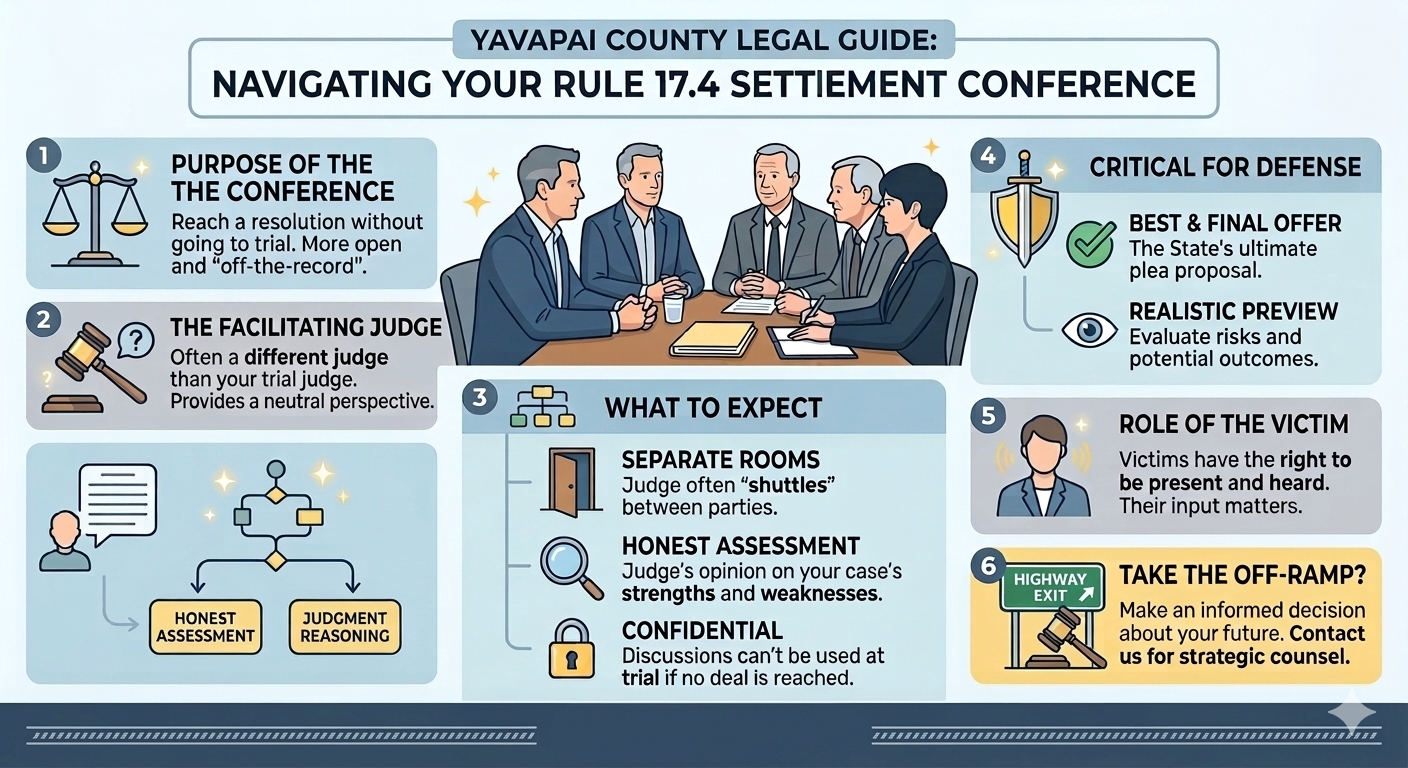
What is a Rule 17.4 Settlement Conference

In the Yavapai County legal system, not every case is resolved through a simple plea offer. When the prosecution and defense are far apart, the court may order a Settlement Conference under Arizona Rule of Criminal Procedure 17.4.

This is a formal meeting designed to help both sides reach an agreement. It is often the final opportunity to resolve a case on your own terms before a jury takes the decision out of your hands.


What is a Rule 17.4 Settlement Conference?

In a standard Pretrial Conference, the judge simply checks the status of the case. In a Settlement Conference, a judge actually becomes a “facilitator.”

Crucially, the judge who oversees the settlement conference is often not the same judge who will preside over your trial. This allows for a more open, “off-the-record” discussion about the strengths and weaknesses of the case without biasing the trial judge.


What Happens During the Conference?

The conference typically takes place in a courtroom or a private conference room at the Yavapai County Superior Court. Here is the typical flow:

  • Separate Rooms: The judge will often move back and forth between the defense and the prosecutor (shuttle diplomacy).
  • Honest Assessment: The settlement judge may give their opinion on how a jury might react to certain evidence or what a likely sentence might look like if you lose at trial.
  • Confidentiality: Under Rule 17.4, these discussions are generally confidential. If you don’t reach a deal, nothing said in the conference can be used against you at trial.

The Role of the Victim

In Arizona, victims have constitutional rights. Under the Victims’ Rights Act, a victim has the right to be present at the settlement conference and to be heard by the judge before any plea agreement is accepted. Their input often heavily influences the prosecutor’s willingness to move on a deal.


Why This Stage is Critical for the Defense

A Settlement Conference is often where we get the “best and final” offer from the State. It allows your lawyer to:

  • Highlight “holes” in the prosecution’s case directly to a neutral judge.
  • Force the prosecutor to reconsider an unreasonable position.
  • Give you a realistic “preview” of your risks before you commit to a trial.

Are you facing a tough decision on a plea offer? A settlement conference requires a strategic approach and a deep understanding of Yavapai County sentencing guidelines. Contact us today to discuss your options.

The Pretrial Conference in Yavapai County: Where the Real Work Happens

If you have recently finished your Arraignment in Prescott, your case will now be scheduled for an Initial Pretrial Conference (IPTC). For many defendants, this period feels like “waiting,” but for your defense team, this is the most active phase of the case.

The Pretrial Conference is not a single event, but often a series of status checks where the judge manages Discovery and Negotiations.


What is “Discovery”? (Rule 15)

Under Arizona Rule of Criminal Procedure 15, the prosecutor is required to turn over all evidence they have against you. This is called “Disclosure.” During the pretrial phase, your lawyer will be reviewing:

  • Police reports and supplemental notes
  • Body cam and dash cam footage
  • Lab results (DNA, blood alcohol, etc.)
  • Witness statements
  • “Brady” material (evidence that might prove your innocence)

The judge uses the Pretrial Conference to ensure the State is meeting its deadlines and that your defense has everything it needs to prepare for trial.


The Two Goals of a Pretrial Conference

1. Managing the Timeline

The judge will check in to see if witness interviews have been conducted and if any motions (like a Motion to Suppress evidence) need to be filed. In Yavapai County, you may have several pretrial conferences spaced 30 to 60 days apart as this evidence is gathered.

2. Plea Negotiations

This is typically when the prosecutor will extend a formal Plea Offer. Your attorney will use the evidence gathered during discovery to point out weaknesses in the State’s case, often negotiating for a reduction in charges or a more favorable sentencing recommendation.


Do You Have to Attend?

In the Yavapai County Superior Court, your attendance is mandatory unless your lawyer has specifically told you otherwise and the court has granted a “waiver of appearance.” Missing a pretrial conference is a violation of your release conditions and will result in a warrant for your arrest.


The Difference Between IPTC and CPTC

You may hear these acronyms used in court:

  • IPTC (Initial Pretrial Conference): The first meeting to set the schedule.
  • CPTC (Comprehensive Pretrial Conference): A later meeting where the court determines if the case is actually ready for trial or if a plea deal is likely.

Is your case heading toward trial? The pretrial phase is where leverage is built. Contact us today to ensure every piece of evidence is scrutinized and your defense is prepared.


What if a Plea Deal Isn’t Reached at Pretrial?

If the prosecution and defense cannot agree on a resolution during the initial conferences, the court may schedule a formal Settlement Conference. This is a dedicated session to see if a trial can be avoided.

Read the next guide: The Settlement Conference: The Last Chance to Settle.

What to Expect at Your Arraignment in Prescott

If you have moved past the Preliminary Hearing or have been indicted by a Grand Jury, your next mandatory court appearance is the Arraignment. In Yavapai County, this usually takes place in the Superior Court building in downtown Prescott.

The Arraignment is a procedural milestone. It is not the time to argue the facts of your case or present evidence; rather, it is the moment where the charges against you are formally read, and you enter a plea.


The Four Main Goals of an Arraignment

During this brief hearing, the judge will address four specific items:

  1. Formal Reading of Charges: The judge will ensure you understand exactly what the Yavapai County Attorney’s Office is charging you with.
  2. Entering a Plea: In almost every case, your attorney will advise you to enter a plea of “Not Guilty.” This is a standard legal step that preserves your right to challenge the evidence later.
  3. Confirming Identity and Address: The court ensures they have your correct contact information for future legal notices.
  4. Setting Future Dates: The judge will schedule your next set of appearances, typically an Initial Pretrial Conference (IPTC).

Superior Court vs. Justice Court

While your earlier hearings might have taken place in a local Justice Court, the Arraignment is almost always held in the Yavapai County Superior Court. This is because felony cases must be handled by the Superior Court once an indictment or a finding of probable cause has occurred.


Release Conditions: Can They Change?

At the Arraignment, the judge will typically “affirm” the release conditions or bond set during your Initial Appearance. However, if your circumstances have changed—for example, if you have secured a new job or stable housing—this may be an opportunity for your lawyer to request a modification of your bond or release terms.


Why You Need a Lawyer Present

While the Arraignment is short, you should never attend it without counsel. Missing a deadline or failing to understand the judge’s orders regarding travel or no-contact restrictions can lead to your release being revoked and you being taken back into custody.


Navigating the Yavapai County Superior Court system? The Arraignment starts the clock on your defense timeline. Contact us today to ensure your rights are protected from day one.

What Happens at a Preliminary Hearing in Yavapai County?

If you have recently attended an Initial Appearance in Prescott, your next major court date will likely be a Preliminary Hearing. This is one of the most critical stages of a felony case in Arizona. It serves as a “gatekeeper” to ensure the government isn’t moving forward with a case based on weak or non-existent evidence.


The Purpose: Proving “Probable Cause”

A Preliminary Hearing is essentially a “mini-trial.” A judge (not a jury) listens to evidence presented by the State to decide two things:

  1. Did a crime actually occur?
  2. Is there a reasonable belief that you committed that crime?

Unlike a trial, where the standard is “beyond a reasonable doubt,” the prosecutor here only needs to prove Probable Cause. This is a much lower bar, but it still requires the State to produce real evidence rather than just accusations.


The “10/20 Day Rule” for Preliminary Hearings

In Yavapai County, the timing of your hearing depends on your current status:

  • In-Custody: If you are being held in jail, the hearing must begin within 10 days of your initial appearance.
  • Out-of-Custody: If you were released on bond or OR, the hearing must happen within 20 days.

What Happens During the Hearing?

The hearing takes place in the Justice Court (like the Prescott Justice Court or Camp Verde). The prosecutor will call witnesses—usually the arresting officer from the Prescott Police Department or YAVAPAI County Sheriff’s Office.

Your defense attorney will have the opportunity to:

  • Cross-Examine Witnesses: We can challenge the officer’s memory, their investigation methods, and the credibility of their evidence.
  • Lock-in Testimony: Getting witnesses to testify under oath early is a huge advantage. If their story changes at trial months later, we use the Preliminary Hearing transcript to discredit them.
  • Argue for Dismissal: If the State fails to show probable cause, we can move for the judge to “scratch” (dismiss) the charges on the spot.

Preliminary Hearing vs. Grand Jury

In Prescott, many cases don’t actually reach the Preliminary Hearing. Instead, the County Attorney often takes the case to a Grand Jury. This is a secret proceeding where neither you nor your lawyer are allowed to attend. If the Grand Jury issues an indictment (a “True Bill”), the Preliminary Hearing is canceled (vacated), and your case moves directly to Arraignment.


Why You Need a Lawyer Before This Hearing

The window between your arrest and your Preliminary Hearing is a high-leverage time for your defense. Often, an experienced lawyer can use this time to:

  • Negotiate with the prosecutor for a “scratch” (dismissal) before the hearing starts.
  • Secure a more favorable plea offer.
  • Collect exculpatory evidence to present to the judge.

Facing felony charges in Prescott? The early stages of your case define the outcome. Contact us today to discuss your strategy before your hearing date.


What Comes After the Preliminary Hearing?

If probable cause is found, or if a Grand Jury issues an indictment, your case moves to the Arraignment in Yavapai County Superior Court. This is where you formally enter your plea.

Read the next guide: What to Expect at Your Arraignment in Prescott.

What Happens at an Initial Appearance After a Felony Arrest in Prescott, Arizona

After a felony arrest in Prescott, one of the first questions families ask is: “When will they see a judge—and can they get out?”

In Yavapai County, those answers usually come at the initial appearance, which is typically held within about 24 hours of arrest (or the person must be released if it doesn’t happen in time).

This guide explains the initial appearance in simple terms—what it is, what the judge decides, how bond and release conditions work, and what to do if the conditions feel too strict.

If you want the full step-by-step roadmap first, start here: What Happens After a Felony Arrest in Prescott, Arizona

Bail and bond process after a felony arrest in Phoenix Arizona showing initial appearance and release options


First Things First: What the “Initial Appearance” Actually Is

The initial appearance is usually the first court hearing after a person is arrested and booked. It is not a trial, and the judge does not decide guilt or innocence here.

Instead, the judge typically:

  • Confirms the defendant’s identity
  • Informs the defendant of the charge(s)
  • Advises the defendant of important rights (like the right to remain silent and the right to an attorney)
  • Sets release conditions (including whether a bond is required)

When the Initial Appearance Happens

In Arizona, a person who is arrested must typically be brought before a judge for an initial appearance within about 24 hours, or the person must be released.

Families are often trying to figure out:

  • Where is the person being held?
  • Will the judge set bond?
  • Are there no-contact orders or other restrictions?

What the Judge Decides at the Initial Appearance

The judge may:

  • Release the person on a promise to appear (OR release)
  • Set a secured bond amount
  • Order supervised release or monitoring
  • Keep the person in custody (if the crime is non-bondable or a high flight risk)

What Happens Next? The Preliminary Hearing

The Initial Appearance is just the beginning. The most critical “gatekeeper” event in your case happens next: the Preliminary Hearing. This is where the state must actually prove they have enough evidence to keep the charges against you.

Learn more about the next stage: What Happens at a Preliminary Hearing in Yavapai County?


Need Help Now?

Initial appearance decisions happen fast. If you or a loved one are facing felony charges in Yavapai County, getting an experienced attorney involved early is the best way to protect your rights.

Request a Free Consultation

1 2 3 6